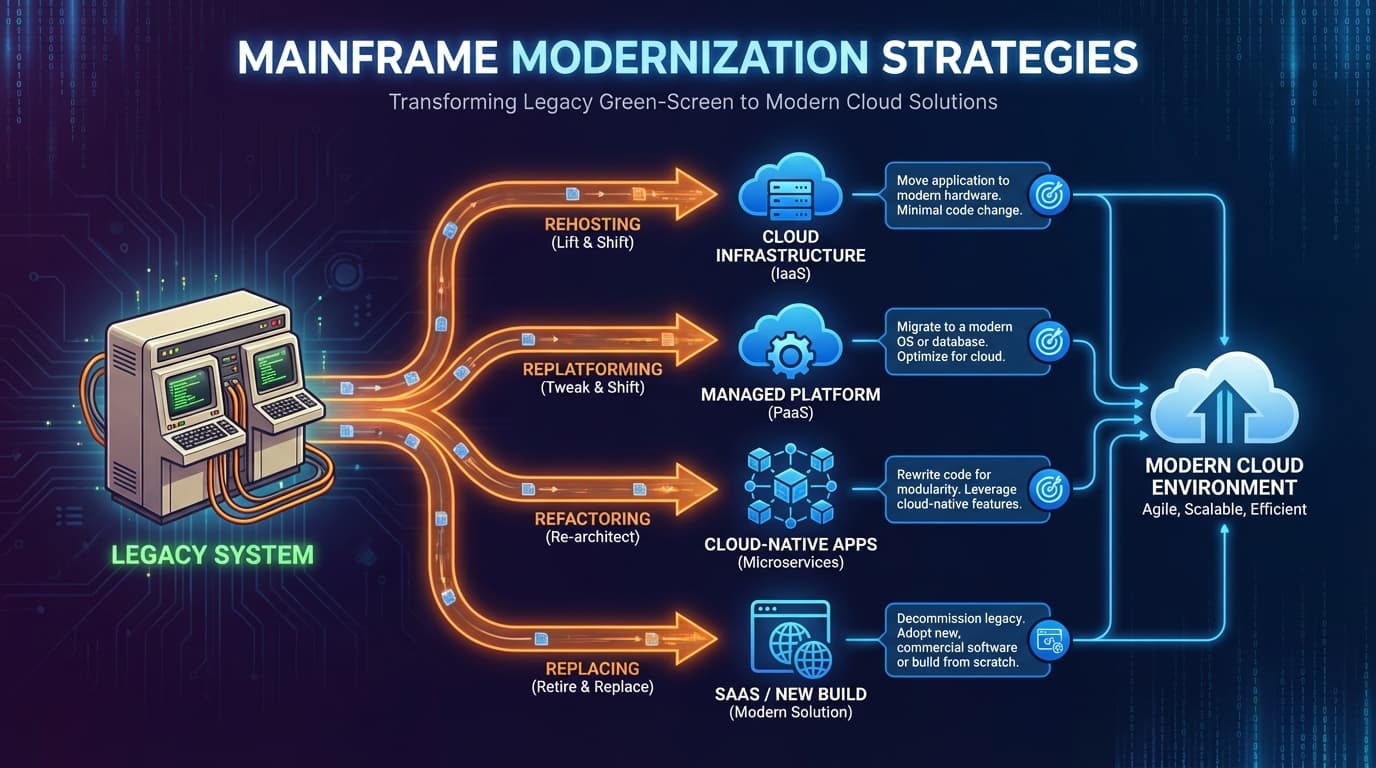
The mainframe is not dead. In fact, 70% of Fortune 500 companies still run critical workloads on mainframes. But here is the uncomfortable truth: the developers who built and maintained these systems are retiring, the talent pool is shrinking, and the cost of keeping mainframes running grows every year. Modernization is not optional—it is inevitable. The question is not whether to modernize, but how.
The Real Cost of Mainframe Inertia
Before discussing modernization options, let us quantify what standing still actually costs:
- Talent scarcity: COBOL developers command premium rates and are increasingly difficult to find. Average age of mainframe specialists exceeds 55.
- Licensing inflation: IBM mainframe licensing costs typically increase 5-10% annually, compounding over time.
- Integration friction: Every modern system integration with the mainframe requires custom middleware and specialized expertise.
- Innovation blockage: Business initiatives stall waiting for mainframe changes that take months instead of weeks.
The most expensive mainframe is not the one you modernize—it is the one you keep running while your competitors innovate.
The Five Modernization Approaches
There is no single correct answer for mainframe modernization. The right approach depends on your specific workloads, risk tolerance, and strategic goals. Here are the five primary options:
Option 1: Rehosting (Lift and Shift)
Move mainframe workloads to modern infrastructure without changing the application code. COBOL runs on Linux or cloud infrastructure using emulation or recompilation.
- Pros: Fastest path off mainframe hardware, lowest initial risk, preserves existing logic
- Cons: Does not address technical debt, still requires COBOL skills, limited cloud-native benefits
- Timeline: 6-18 months depending on complexity
- Best for: Organizations needing to exit mainframe licensing quickly while planning longer-term transformation
Vendors like Micro Focus, LzLabs, and AWS Mainframe Modernization offer rehosting platforms. But be warned: this is often "lift and hope" rather than true modernization.
Option 2: Replatforming
Move to modern infrastructure with minimal code changes. Replace mainframe middleware (CICS, IMS, DB2) with modern equivalents while keeping business logic largely intact.
- Pros: Reduces mainframe dependencies, enables some cloud capabilities, moderate risk
- Cons: Still carries legacy code patterns, requires careful middleware mapping
- Timeline: 12-24 months
- Best for: Organizations with stable COBOL applications and clear middleware dependencies
Option 3: Automated Refactoring
Use automated tools to convert COBOL to modern languages (Java, C#, or cloud-native languages). Preserve business logic while generating maintainable modern code.
- Pros: Eliminates COBOL dependency, produces code modern developers can maintain
- Cons: Automated conversion quality varies significantly, generated code may not follow modern patterns
- Timeline: 12-36 months
- Best for: Organizations with well-structured COBOL and clear business logic separation
Key vendors include Blu Age, TSRI, and Modern Systems. Quality assessment before committing is essential—some codebases convert better than others.
Option 4: Manual Refactoring
Rewrite applications in modern languages with modern architecture. Extract business rules from COBOL and implement them in cloud-native applications.
- Pros: Produces genuinely modern applications, enables full cloud-native capabilities, eliminates all legacy dependencies
- Cons: Highest cost and risk, longest timeline, requires deep business domain expertise
- Timeline: 24-60 months for major systems
- Best for: Strategic systems where competitive advantage justifies investment
Option 5: Replacement
Replace mainframe applications with commercial off-the-shelf (COTS) software or SaaS solutions. Why maintain custom code when packaged solutions exist?
- Pros: Eliminates custom code maintenance entirely, benefits from vendor R&D
- Cons: Business process changes required, may lose competitive differentiation, vendor lock-in
- Timeline: 18-36 months
- Best for: Commodity functions (HR, finance) where differentiation is not strategic
The Hybrid Reality
Most successful mainframe modernizations combine multiple approaches. A typical pattern:
- Replace commodity functions with SaaS (HR, basic finance)
- Refactor strategic applications (customer-facing, revenue-generating)
- Rehost stable, low-change applications
- Retire obsolete applications entirely
The key is portfolio analysis: categorize every mainframe workload by strategic value, change frequency, and complexity.
The Assessment Framework
Before choosing an approach, assess your mainframe portfolio across five dimensions:
1. Business Criticality
How essential is this application to business operations? Core revenue systems demand different treatment than back-office batch processing.
2. Code Quality
Is the COBOL well-structured with clear separation of concerns? Or is it 40 years of accumulated spaghetti code? Code quality dramatically affects modernization options.
3. Change Velocity
How often does this application change? High-change applications benefit most from modernization. Stable applications may be fine with rehosting.
4. Integration Complexity
How tightly coupled is this application to other mainframe systems? Deeply integrated applications require coordinated modernization.
5. Data Volume and Sensitivity
What data does this application process? GDPR-sensitive data has compliance implications for any modernization approach.
Common Pitfalls
Pitfall 1: Underestimating Data Complexity
Mainframe data structures (VSAM, hierarchical databases, packed decimal formats) do not map cleanly to modern databases. Data migration is often the hardest part.
Pitfall 2: Ignoring JCL and Batch Processing
Mainframe job control language orchestrates complex batch workflows. Modernizing the COBOL without modernizing the JCL leaves you with a half-modern system.
Pitfall 3: Forgetting the People
Your mainframe team has decades of institutional knowledge. Involve them in modernization—they know where the bodies are buried and what the code really does.
Pitfall 4: Big Bang Expectations
Attempting to modernize everything at once maximizes risk. Successful modernizations are incremental, with continuous validation.
Building the Business Case
Mainframe modernization requires significant investment. Here is how to build a compelling business case:
- Quantify current costs: Hardware, software licensing, facilities, power, and cooling. Do not forget opportunity costs.
- Project talent costs: Mainframe developer rates will only increase as supply shrinks.
- Calculate agility value: What is faster time-to-market worth for new business capabilities?
- Include risk factors: What happens if a key mainframe developer leaves? What are the security implications of unsupported software?
DACH-Specific Considerations
Mainframe modernization in Germany, Austria, and Switzerland carries additional considerations:
- Data residency: Many DACH organizations require data to remain in EU or DACH-specific data centers
- Works councils: Major IT changes require works council involvement and consultation
- Industry regulations: Banking (BaFin), insurance, and healthcare sectors have specific technology requirements
- Vendor landscape: European service providers and German-speaking implementation teams are often preferred
Starting Your Modernization Journey
Mainframe modernization is a multi-year journey, but it starts with understanding what you have. Our assessment process analyzes your mainframe portfolio, identifies the right approach for each workload, and builds a realistic roadmap.
Your mainframe has served your organization well. Now it is time to plan its evolution—not because the technology failed, but because your business needs have outgrown it. Ready to explore your options?