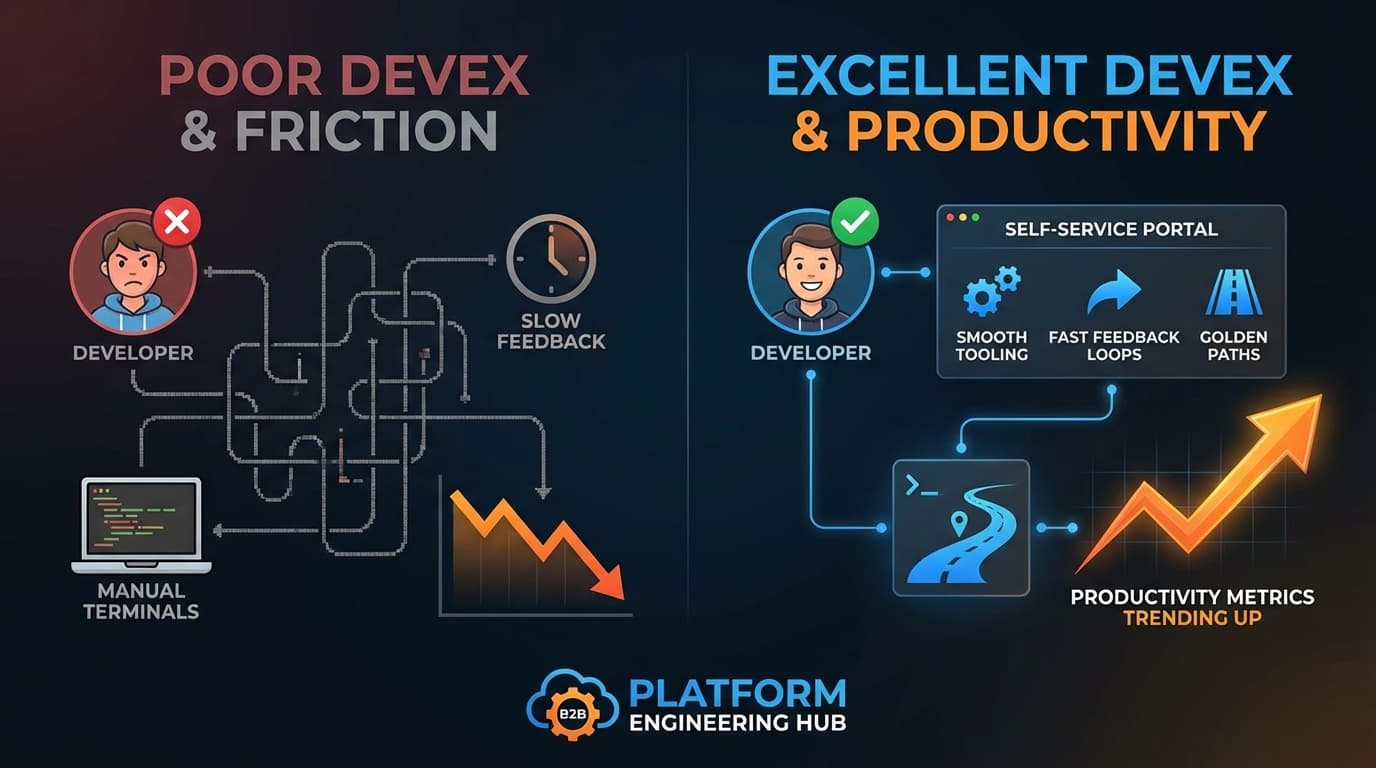
Your organization is in a war for developer talent. You pay competitive salaries. You offer remote work. But your developers still leave—and when you ask why, they talk about slow builds, confusing processes, and the feeling that they spend more time fighting tools than writing code. Developer experience is the hidden factor that determines whether your best engineers stay or leave.
What Is Developer Experience?
Developer experience (DevEx) encompasses everything that affects how developers feel about their work: the tools they use, the processes they follow, the feedback loops they experience, and the cognitive load they carry. Good DevEx means developers can focus on solving problems. Bad DevEx means they spend their energy on everything except building value.
Developer experience is not about making developers comfortable. It is about removing friction that prevents them from doing their best work.
The Cost of Poor Developer Experience
Studies consistently show that developers spend only 30-40% of their time actually writing code. The rest goes to:
- Waiting: Builds, tests, deployments, approvals
- Searching: Documentation, code, configuration, the right person to ask
- Context switching: Meetings, interruptions, juggling multiple projects
- Fixing tooling: Environment issues, flaky tests, broken pipelines
For a team of 50 developers at average European salaries, improving coding time from 35% to 50% represents over 1 million euros in recaptured productivity annually. That is before counting reduced turnover, faster delivery, and better quality.
The Three Dimensions of DevEx
Research from Google and others identifies three core dimensions that determine developer experience:
1. Feedback Loops
How quickly do developers know if their change works? Feedback loops include:
- Local development: How fast can you test a change locally?
- CI/CD: How long until the pipeline tells you pass/fail?
- Code review: How quickly do reviewers respond?
- Production: How soon do you know if the deployment succeeded?
Every minute added to feedback loops is a minute of lost productivity—and a minute of context decay where developers forget what they were doing.
2. Cognitive Load
How much must developers hold in their heads to do their work? Cognitive load includes:
- System complexity: How many services must they understand?
- Process complexity: How many steps to deploy a change?
- Tribal knowledge: How much is documented versus known only by veterans?
- Tool proliferation: How many different systems must they navigate?
High cognitive load leads to mistakes, slower onboarding, and burnout. Simplification is not laziness—it is a productivity strategy.
3. Flow State
How often do developers achieve and maintain deep focus? Flow state depends on:
- Interruptions: Meetings, Slack messages, context switches
- Autonomy: Can they make decisions, or must they wait for approvals?
- Clear goals: Do they know what success looks like?
- Appropriate challenge: Is the work engaging but not overwhelming?
One study found it takes 23 minutes to return to deep focus after an interruption. Four interruptions per day can eliminate all productive coding time.
High-Impact DevEx Improvements
You cannot fix everything at once. These investments typically deliver the highest returns:
Speed up builds and tests
Every 10% reduction in CI time compounds across every commit, every developer, every day. Invest in:
- Parallel test execution
- Build caching and incremental builds
- Faster hardware for CI runners
- Test impact analysis to run only relevant tests
Improve onboarding
New developers should be able to commit working code on day one. That requires:
- One-command development environment setup
- Self-contained documentation with working examples
- Clear contribution guidelines
- Automated validation that catches common mistakes
Reduce required knowledge
Platform engineering creates abstractions that reduce cognitive load:
- Golden paths for common tasks
- Self-service infrastructure
- Sensible defaults that work without configuration
- Internal developer portals that aggregate information
Protect focus time
Cultural changes are hard but high-impact:
- No-meeting days or focus blocks
- Asynchronous communication defaults
- Clear escalation paths so not everyone needs to be available
- Smaller teams with clear ownership
Measuring Developer Experience
You cannot improve what you do not measure. Key DevEx metrics include:
Quantitative metrics:
- Build time: p50 and p90 for local builds and CI
- Deploy frequency: How often can teams ship?
- Lead time: From commit to production
- Change failure rate: How often do deployments cause incidents?
- Onboarding time: Days until first productive commit
Qualitative metrics:
- Developer satisfaction surveys: Regular pulse checks on tooling, processes, culture
- SPACE framework surveys: Satisfaction, Performance, Activity, Collaboration, Efficiency
- Exit interview themes: Why do developers leave?
DevEx in the DACH Market
German-speaking markets have specific DevEx considerations:
- Works council involvement: Monitoring and productivity tracking may require approval
- Strong employment protection: Invest in existing developers; hiring is harder
- Engineering culture: German engineers often value stability and quality over move fast and break things
- Remote work expectations: Post-pandemic, DevEx must work for distributed teams
Getting Started
DevEx improvement starts with understanding your current state:
- Survey your developers: What frustrates them most? What do they wish worked better?
- Measure your baselines: Build times, deploy frequency, onboarding duration
- Identify quick wins: What can you fix in a week that developers encounter daily?
- Create a DevEx roadmap: Prioritize improvements by impact and effort
- Assign ownership: Someone should be accountable for DevEx metrics
DevEx Is a Product
The most successful organizations treat developer experience as a product with developers as customers. They have product managers for internal tooling. They do user research. They prioritize based on impact, not just squeaky wheels.
Developer experience is not a nice-to-have. In a competitive talent market, with pressure to deliver faster, DevEx is how you retain your best people and enable them to do their best work. The organizations that invest in DevEx will outpace those that do not.