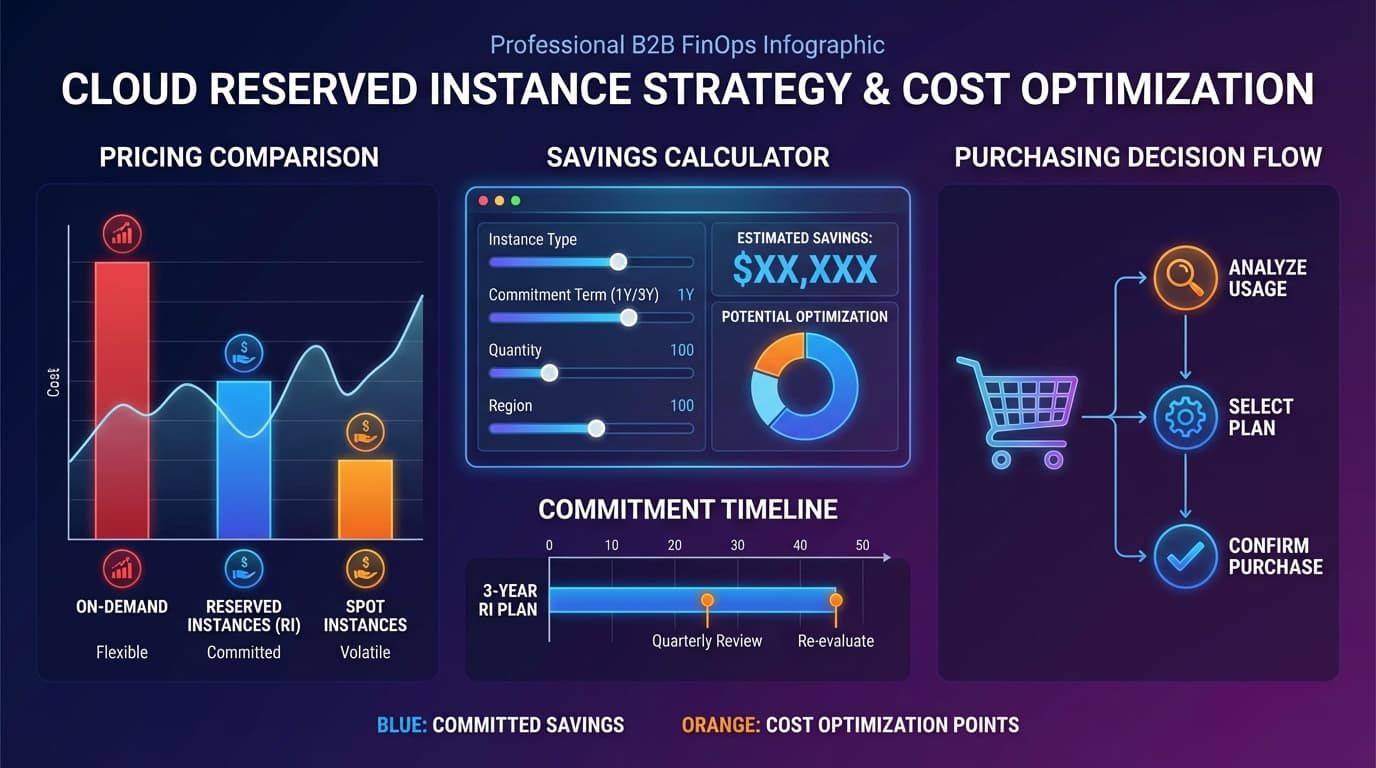
Reserved Instances promise 30-72% savings compared to on-demand pricing. The pitch is compelling—commit to capacity, get a discount. But the reality for most enterprises is different: underutilized reservations, mismatched instance types, and savings that evaporate when workloads change. Here's how to buy Reserved Instances strategically.
The Reserved Instance Trap
Most enterprises approach RI purchases wrong. They look at current usage, buy reservations to match, and declare victory. Twelve months later, they discover their savings are far below expectations.
The problems compound: applications modernize, teams adopt containers, workloads shift to different instance families. The reservations that made sense at purchase become anchors dragging down your FinOps metrics.
Reserved Instances are a financial instrument, not a technical decision. Treat them accordingly.
Understanding RI Economics
Before buying anything, understand what you're actually purchasing:
AWS Reserved Instances
- Payment options: All Upfront (biggest discount), Partial Upfront, No Upfront
- Terms: 1-year (smaller discount) or 3-year (larger discount)
- Scope: Regional (flexible) or Zonal (specific availability zone)
- Flexibility: Convertible RIs can be exchanged; Standard RIs cannot
Azure Reserved VM Instances
- Payment: All upfront or monthly payments
- Terms: 1-year or 3-year
- Scope: Single subscription, resource group, or shared
- Flexibility: Instance size flexibility within same series
GCP Committed Use Discounts
- Types: Resource-based (specific vCPU/memory) or Spend-based (dollar commitment)
- Terms: 1-year or 3-year
- Flexibility: Spend-based CUDs offer more flexibility
The Strategic Buying Framework
Step 1: Analyze Usage Patterns (Not Just Current Usage)
Don't just look at what you're using today. Analyze:
- Trend analysis: Is usage growing, shrinking, or stable?
- Variability: How much does usage fluctuate?
- Planned changes: What migrations, modernizations, or shutdowns are coming?
- Instance family trends: Are you moving toward newer instance types?
Step 2: Calculate Your Baseline
Identify your minimum committed capacity—the floor below which usage never drops. This is your safe RI purchase zone.
- Look at 90-day minimums: Not averages, minimums
- Account for seasonality: What's your lowest-usage period?
- Subtract planned reductions: Migrations, retirements, modernization
- Apply a safety margin: 10-20% below calculated minimum
Step 3: Layer Your Commitment Strategy
Don't buy all RIs at once. Layer commitments by confidence level:
- High confidence (60-70% of baseline): 3-year term, maximum discount
- Medium confidence (20-30%): 1-year term, moderate discount
- Variable (remaining): On-demand or Savings Plans for flexibility
Step 4: Choose Flexibility Over Maximum Discount
The highest discount isn't always the best value. Consider:
- Convertible over Standard: Smaller discount but exchangeable when needs change
- Savings Plans over RIs: More flexible, apply across services
- Regional over Zonal: Apply across availability zones automatically
- Shared scope: Let reservations float across accounts/subscriptions
Common Mistakes to Avoid
Mistake 1: Buying to Match Current State
Your cloud environment will change. Teams will modernize. Applications will containerize. Instance families will evolve. Buying RIs based solely on current usage locks in today's architecture.
Mistake 2: Ignoring Instance Family Changes
Cloud providers release new instance generations regularly. The m5 instances you reserve today may be superseded by m6 or m7 instances that offer better price/performance. Standard RIs don't adapt; Convertible RIs do.
Mistake 3: Over-Committing to 3-Year Terms
3-year terms offer the best discounts but assume your needs won't change significantly. In cloud, three years is an eternity. Balance discount optimization against flexibility needs.
Mistake 4: Forgetting About Utilization
An RI you don't use costs money. An RI that's 50% utilized delivers 50% of its potential savings. Track RI utilization religiously and take action on underutilized reservations.
Mistake 5: Buying RIs for Variable Workloads
Dev/test environments, batch processing, and variable workloads are poor RI candidates. Use spot instances, auto-scaling, and on-demand for variable capacity.
Savings Plans: The Modern Alternative
AWS Savings Plans and Azure Savings Plans offer an alternative worth considering:
- Commitment: Dollar amount per hour, not specific instances
- Flexibility: Apply across instance families, sizes, and regions
- Discount: Slightly lower than equivalent RIs, but more adaptable
- Best for: Organizations with evolving architectures
For many enterprises, Savings Plans are now the better default choice. RIs still make sense for stable, predictable workloads on specific instance types.
Building a FinOps Practice
RI buying isn't a one-time activity. Build ongoing practices:
- Monthly utilization reviews: Track RI usage against purchased capacity
- Quarterly strategy reviews: Adjust buying strategy based on trends
- Automated recommendations: Use cloud provider tools to identify opportunities
- Cross-functional alignment: Coordinate with teams planning infrastructure changes
- RI marketplace: Sell unused RIs on AWS Marketplace (when available)
The Bottom Line on RIs
Reserved Instances deliver real savings—when purchased strategically. The key is treating RI purchases as financial planning, not capacity planning. Understand your baseline, layer your commitments, prioritize flexibility, and maintain ongoing optimization.
Need help optimizing your cloud costs? Our FinOps team has helped DACH enterprises save millions through strategic RI purchasing, Savings Plans optimization, and comprehensive cost management. We can help you build a cloud cost strategy that delivers sustainable savings.