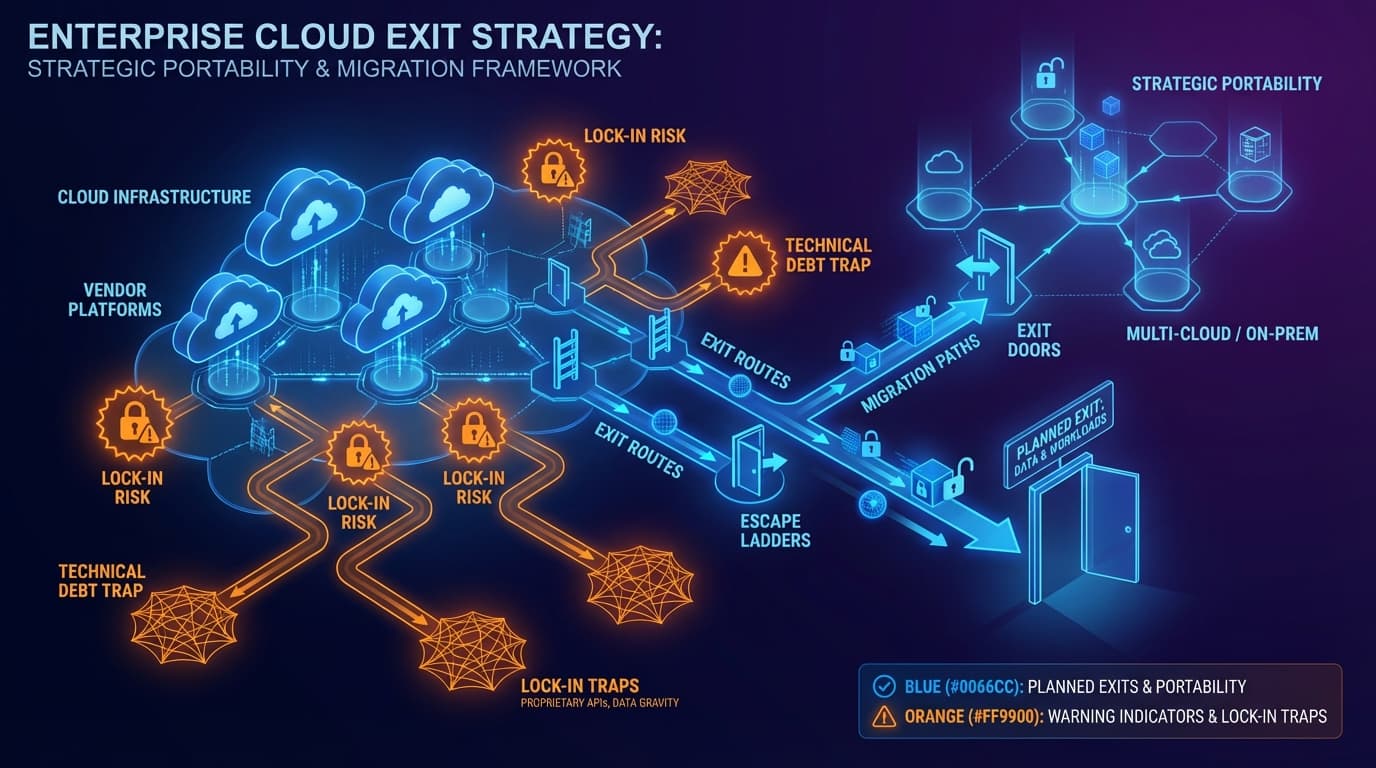
Nobody talks about cloud exit strategies. Not vendors, obviously—they want you locked in. Not consultants pushing cloud migrations—exit planning doesn't sell. But every enterprise signing a major cloud commitment should have an exit plan before the ink dries. Here's why, and how to build one.
Why Exit Planning Matters
An exit strategy isn't about planning to leave. It's about maintaining negotiating leverage and reducing risk. The moment you're perceived as unable to leave, your cloud vendor's pricing and service incentives change dramatically.
We've seen DACH enterprises face 40-60% price increases at renewal because they had no credible exit option. Their cloud provider knew it. The cost of migration exceeded the cost of staying, no matter how painful staying became.
The best time to plan your cloud exit is before you enter. The second best time is now.
The Three Exit Scenarios
A comprehensive exit strategy covers three scenarios, each with different planning requirements:
1. Provider Migration
Moving from one cloud provider to another. This is the most common scenario—typically driven by cost, service quality, or strategic alignment changes.
- Timeline: 12-24 months for significant workloads
- Cost: Typically 1.5-2x annual cloud spend for migration
- Key challenge: Service-to-service mapping and data transfer
2. Repatriation
Bringing workloads back to on-premises or colocation facilities. Increasingly common as enterprises realize not everything belongs in public cloud.
- Timeline: 18-36 months including infrastructure procurement
- Cost: High capital expenditure, but potentially lower TCO
- Key challenge: Rebuilding operational capabilities
3. Business Continuity
Emergency exit due to provider failure, geopolitical issues, or regulatory requirements. Think through scenarios like a major cloud outage lasting weeks, not hours.
- Timeline: Must be executable in days to weeks
- Cost: Premium for speed and parallel running
- Key challenge: Having warm standby infrastructure ready
Building Your Exit Strategy: The Five Pillars
1. Data Portability
Your data is your leverage. Ensure you can extract it efficiently.
- Regular exports: Test full data extraction quarterly
- Standard formats: Avoid proprietary data formats where possible
- Egress planning: Budget for data transfer costs—they're significant
- Data mapping: Document where every critical dataset lives
2. Architecture Abstraction
Minimize direct dependencies on provider-specific services.
- Containers: Kubernetes runs on any cloud (with some effort)
- Infrastructure as Code: Terraform is more portable than CloudFormation
- API abstraction: Wrap provider-specific APIs in your own interfaces
- Database choices: PostgreSQL is more portable than Aurora or Cloud Spanner
3. Operational Knowledge
Don't outsource all cloud knowledge to your provider or a single partner.
- Internal capability: Maintain core cloud operations skills in-house
- Documentation: Document configurations, not just infrastructure
- Multi-cloud exposure: Consider secondary cloud for non-critical workloads
- Disaster recovery: Use a different provider for DR if practical
4. Contract Terms
Negotiate exit-friendly terms before you sign.
- Data extraction: Contractual right to extract data at reasonable cost
- Transition assistance: Provider support during migration out
- Price protection: Caps on renewal increases
- Early termination: Understand penalties and negotiate them down
5. Cost Visibility
Know your true cloud costs to make informed exit decisions.
- Detailed tagging: Track costs by application, team, and environment
- Migration modeling: Build comparative TCO models for alternatives
- Hidden costs: Include training, tool replacement, and productivity loss
- Exit triggers: Define cost thresholds that trigger exit evaluation
The Exit Readiness Assessment
Score your organization on these criteria (1-5 scale):
- Can you extract all critical data within 30 days?
- Is your infrastructure defined in portable code?
- Do you have internal skills to operate on an alternative platform?
- Are your contracts exit-friendly?
- Do you know your true, fully-loaded cloud costs?
A score below 15 means you're more locked in than you should be. Above 20, you're in a strong negotiating position.
When Exit Strategy Becomes Exit Execution
Exit planning is an ongoing practice, not a one-time exercise. Review your exit strategy annually. Update cost models. Test data extraction. Verify that your architecture abstractions still work.
The goal isn't to leave your cloud provider—it's to have the credible option to leave. That option changes every negotiation, every service discussion, every pricing conversation.
Need help assessing your cloud exit readiness? Our team has guided DACH enterprises through cloud provider evaluations, negotiations, and migrations. We can help you build the leverage you need—before you need it.