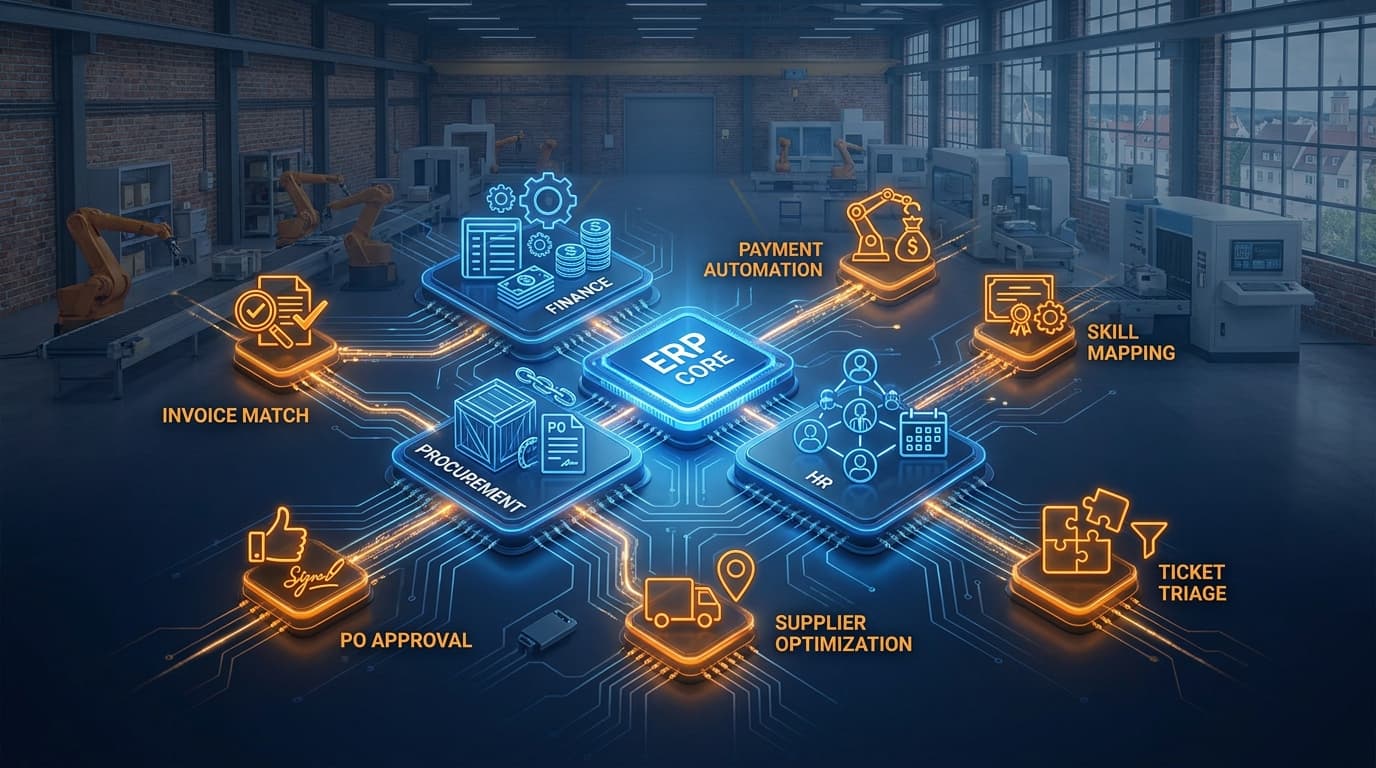
The Mittelstand AI conversation in 2026 has split cleanly in two. One half is the "AI is going to transform everything" pitch from consultancies; the other half is "what should I actually do in our ERP next quarter" from CIOs. This article is for the second half. The most valuable agents in mid-market German enterprises are not consumer-style chatbots. They are small, named verbs working inside SAP, Oracle EBS, NetSuite or comparable ERPs — automating the boring middle of business processes that already exist.
The opportunity is in the middle of processes, not the ends
It helps to look at where ERP work is genuinely slow today. The bottlenecks are rarely at the start (data entry is well-handled) or at the end (reporting is well-handled). They are in the middle:
- Matching invoices to purchase orders when fields do not quite line up.
- Routing approvals through complex hierarchies with substitute rules.
- Reconciling shipments to ASNs to inventory counts.
- Triaging support tickets to the right product/region team.
- Investigating exceptions in master data — the duplicate customer, the inconsistent address, the missing tax code.
Each of these has the same structure: a routine action that is mostly mechanical, with a long tail of judgement-required exceptions. That is exactly the shape an agent serves well — automate the mechanical majority, route the genuine exceptions to a human.
Why an agent beats classic RPA here
RPA — the wave of bots that record and replay clicks — handled the easy 60% of these flows for many enterprises in the late 2010s. The remaining 40% is where RPA breaks: when fields shift, when an exception requires judgement, when the rule has a "usually except…" clause. Agents handle that 40% better for three reasons:
- Reading semi-structured data. An invoice in a slightly new layout does not break an agent the way it breaks an RPA bot.
- Reasoning about exceptions. "This invoice does not match a PO; check whether it is a known supplier with retroactive PO practice; if so, route to the procurement team; if not, flag as suspicious."
- Speaking natural language. The exception note an agent writes for the human handler is genuinely useful; the audit trail it produces is genuinely readable.
None of this means agents replace RPA wholesale. The reality is hybrid: deterministic automation for stable flows, agentic handling for the variable middle, RPA orchestration for the mechanical chain.
Five concrete use cases that consistently work
Field experience with Mittelstand teams in 2026 shows the same five patterns landing well:
1. Three-way match with exception reasoning. The agent compares invoice, PO and goods receipt. Clean matches post automatically. Mismatches get a structured exception ticket with the agent's diagnosis ("vendor invoiced for 105 units; GR shows 100; check whether the PO has a 5% tolerance clause"). Procurement handles only the exceptions.
2. Customer master deduplication. The agent reads new customer records and surfaces probable duplicates with reasoning. Master data stewards confirm or reject. Over weeks the agent learns the team's edge cases.
3. Sales-order completeness check. Before an order proceeds, the agent verifies that all required tax codes, payment terms, shipping windows and product mappings are sane against the customer's history. Inconsistencies are caught at order entry, not at shipping.
4. Service-ticket triage. The agent reads the inbound ticket text, identifies the affected product line, urgency and likely cause, routes to the right team, and pre-drafts the standard initial response. Support agents start from a structured queue, not an inbox.
5. Period-end checklist execution. Many month-end and year-end procedures are checklists that humans tick off manually. An agent that knows the checklist can run most steps, flag the ones requiring judgement, and produce a completion log the auditor can verify.
None of these are exotic. All of them save real hours in the typical Mittelstand finance, procurement or service organisation.
How to scope a first project
The pattern that consistently delivers value:
- Pick one process that runs at least a thousand times a month and where you can name the exceptions today.
- Build the agent around three or four narrow ERP-facing tools (an MCP server in front of your ERP is the cleanest architecture; if your ERP vendor offers an equivalent, use it).
- Pilot in shadow mode. The agent runs in parallel with the existing process; humans still do the work. Compare the agent's decisions against human decisions for two weeks.
- Promote to suggest mode. The agent's decisions become the default; humans confirm or override.
- Promote to auto mode for clean cases only. Exceptions still go to humans. Track auto-rate and override-rate weekly.
The discipline of pilot → suggest → auto is what keeps the project safe. Skipping straight to auto mode is what produces the post-incident memos that set Mittelstand AI back two quarters.
The agent does not have to be smart. It has to be reliable on the mechanical 80% and honest about the judgemental 20%.
Governance for a Mittelstand IT department
Mid-market governance does not need to be heavy. A workable minimum:
- A short register of ERP agents in use, with owner, scope and risk tier.
- A clear rule about which agents can write to the ERP and which can only read.
- An audit log of every agent decision, kept long enough to satisfy your sector's retention rules.
- A monthly review of the override rate. If humans are overriding agent decisions more than 10% of the time, the agent needs tuning or the process needs simplification.
This fits on one page. It is not the GDPR register. It is the operational artefact that keeps your AI use defensible.
The cost case
Honest economics for a typical Mittelstand AI agent project: build cost is modest (weeks, not quarters, if the process is well-scoped), running cost is dominated by model invocations on the ERP-facing tools, payback is usually two to four quarters depending on the volume of the underlying process. The risk is not financial; it is reputational if you ship without the pilot → suggest → auto discipline.
What this is not
Honest scope: ERP agents are not "AI strategy." They are an operational improvement that lets your team handle more volume with the same headcount, or the same volume with cleaner exceptions. They do not replace your CRM rethink, your data-platform investment or your broader digitisation programme. They sit alongside those programmes and accelerate their day-to-day expression.
For most Mittelstand IT leaders in 2026, that is the right calibre of ambition. The companies that quietly automate the middle of their ERP processes this year are the ones whose finance teams ask for less headcount in next year's planning round — and that is the strongest signal a CIO can give.