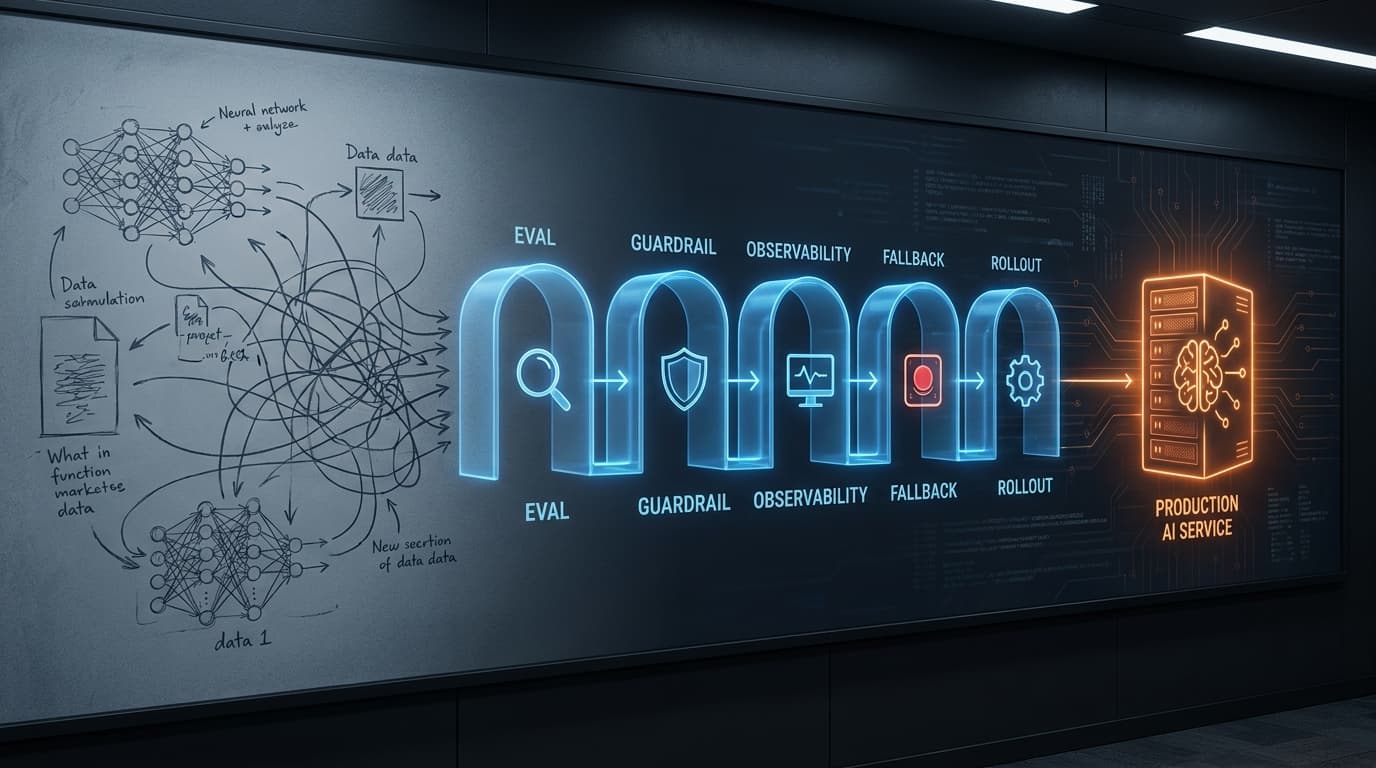
Inside almost every enterprise in 2026 there is a shelf full of AI prototypes that demoed beautifully and never reached real users. Inside the same enterprises there are usually one or two AI systems that quietly process millions of transactions, save real money, and have not made the news. The difference between the two groups is not the technology — they often use the same models — but a small set of operational patterns that the production systems all share. These are the six patterns that consistently separate the production from the proof-of-concept.
1. The eval set comes before the prompt
The first artefact a serious AI project produces is not a prompt. It is a set of 50 to 200 representative inputs with known correct outputs. The team agrees on what "correct" means before any model is invoked.
This artefact does the most important work in the project. It forces explicit agreement on what the system is meant to do. It gives the team an objective scoreboard, which means model improvements are visible and regressions are caught. It is the single best predictor of whether the project will ever reach production. Teams that skip this step are still arguing about quality at month six.
2. The boundary is named
Production AI systems have an explicit description of what they will and will not handle. "Answer questions about HR policy from documents in this folder; refuse questions about payroll, refuse questions about specific individuals, refuse questions outside HR policy." Written down. Communicated to users.
Prototypes that try to handle "anything the user might ask" fail to define their own quality bar. Production systems that narrowly define their scope can be evaluated, governed and confidently shipped.
3. Guardrails are real, not decorative
Production AI systems refuse to answer when they should not. They refuse with grace and explanation: "I cannot find that in our knowledge base," "I am not able to make decisions about personnel matters," "Please contact a human for this question." Refusals are a feature.
The contrast is the prototype that confidently invents answers when retrieval fails. Users learn within a week that the system is unreliable; trust never recovers. The guardrail is what protects the project from its own most-likely failure mode.
"It is right when it answers" is a low bar. "It refuses when it should not answer" is the bar that matters in production.
4. Observability is built in, not bolted on
Production AI systems log every request, every retrieved context, every generated answer, every user feedback signal. They expose dashboards showing daily quality metrics, refusal rates, latency distributions, and cost-per-conversation.
The team that has this dashboard answers the executive question "how is the AI doing" with data. The team that does not answers with anecdotes. After the second anecdote, leadership starts asking different questions.
5. Cost ceilings are explicit
Every production AI system has a documented per-user, per-day or per-month spend ceiling. Most of the time the ceiling is far above normal usage; the ceiling exists so that when a user, an integration or a runaway loop pushes the system to behave abnormally, the bill cannot grow unbounded.
This pattern is invisible until it saves you. The teams that have ceilings sleep well; the teams that do not are one buggy integration away from a Slack message no one wants to write.
6. The fallback is a human, not a smaller model
Production AI systems have a clear path for when they cannot help. The path leads to a human — a service agent, a ticket queue, a colleague's calendar — not to a more frustrated retry. The fallback is communicated to the user without shame ("I cannot help with this; let me connect you to someone who can").
Prototypes that present the AI as the final answer lose users the moment the AI fails. Production systems that frame the AI as the fast path with a human safety net retain users even when the AI is wrong.
The pattern beneath the patterns
All six are variations on a single theme: production AI succeeds when the team treats it as a normal operational system that happens to use a probabilistic component. The model is one component; the eval set, the boundary, the guardrails, the observability, the cost ceilings and the fallback are the operational scaffolding that makes the probabilistic component safe to ship.
Prototypes are about whether the model can produce the right answer. Production is about whether the system holds when the model produces the wrong one. That is a different design problem, and one that the same engineering disciplines you use everywhere else solve cleanly.
What this looks like in your next project
A practical sequence for a team starting a new enterprise AI project this quarter:
- Week one: Build the eval set. Agree on the boundary in writing.
- Week two: Build the minimum viable system. Run it against the eval set. Capture every input and output to your logging stack.
- Week three: Add guardrails and the human fallback path. Define cost ceilings.
- Week four: Internal alpha with five willing users. Watch the dashboards.
- Weeks five to eight: Iterate on retrieval, prompts and tools based on observed eval-set scores and user behaviour.
- Week nine onward: Staged rollout, with the same dashboards and ceilings in front of a growing user base.
That is not a fast plan. It is a plan that ends with a production system in three months instead of a prototype that lives forever on a shelf. For enterprise AI in 2026, that is the trade worth making.
Why the discipline is the differentiator
The technology gap between enterprise AI systems narrowed significantly in the past two years. Most projects can pick a credible model, a credible vector database and a credible agent framework. The remaining gap — the one that decides which projects matter to the business in 2027 — is operational discipline. The six patterns above are how that discipline shows up in a codebase. The teams that build them in early are the teams whose AI projects compound. The teams that hope to add them later are the teams whose prototypes stay prototypes.