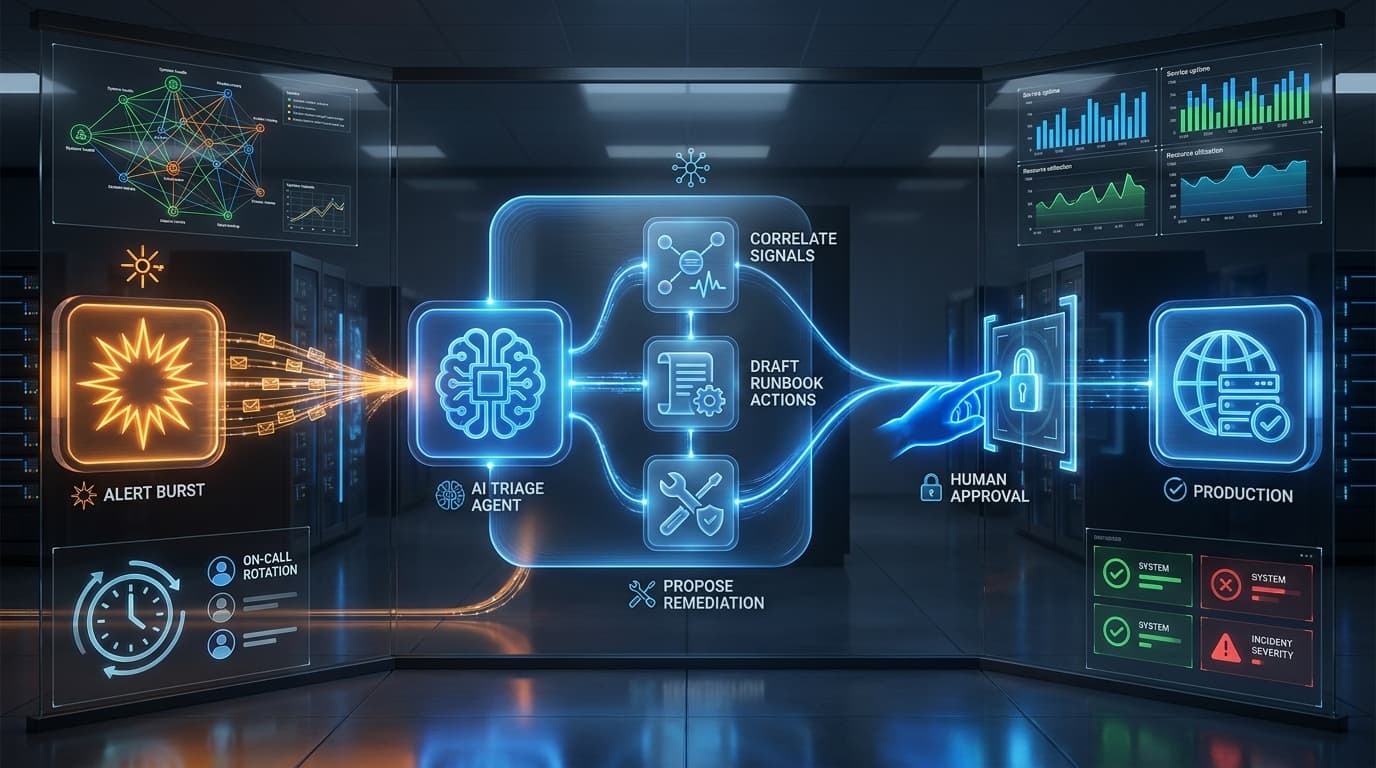
The pitch deck version of "AI for SRE" promises autonomous remediation: the agent detects, decides and fixes while the on-call sleeps. The 2026 production reality is more useful and more conservative. AI agents are quietly making on-call rotations easier by handling the parts of incident response that consume the most human attention without actually requiring human judgement — alert correlation, runbook drafting, triage routing, and the first ninety seconds of "what is this and where do I start." The remediation itself stays human-approved. That balance is the part worth understanding.
Where AI helps before the page
Most pages should not happen. Alert correlation — recognising that twelve simultaneous alerts are one underlying event — is repetitive work that AI handles well. An agent watching the alert stream can:
- Group correlated alerts into a single inferred incident.
- Suppress noise from known transient conditions.
- Enrich each incident with the most-recent deploy, the affected service ownership, and the relevant dashboards.
- Decide whether the incident warrants paging based on policy you defined.
The result is fewer pages, with better context. The on-call who does get paged opens a richer incident than the one that arrived before AI correlation. That alone has saved enough sleep across DACH on-call rotations to be the most popular AI-SRE pattern of 2026.
Where AI helps during the page
The first ninety seconds of an incident are the most cognitively expensive. The on-call is figuring out what is broken, who else needs to know, and where the relevant runbook lives. An AI agent that already did the homework saves real time:
- Hypothesis draft. Based on the alert pattern, recent deploys and historical incidents, the agent proposes two or three likely causes ranked by probability.
- Runbook surfacing. The agent finds and links the most relevant runbook, with the specific steps highlighted that match the current symptoms.
- Owner notification draft. The agent drafts the Slack message announcing the incident, the customers possibly affected, and the expected next steps. The human edits and sends.
- Diagnostic command suggestions. The agent suggests the next three diagnostic queries the on-call would have run anyway. They run with one click each — and the results inform the agent's next suggestions.
None of these take judgement away from the human. All of them remove the parts of the work that did not need judgement.
Where AI does not autonomously fix things
The temptation to let the agent execute remediation directly is real. The 2026 production wisdom, learned the hard way at several DACH enterprises, is to resist it for anything that touches production state. The pattern that holds up:
- The agent proposes the remediation in a structured form: command, expected effect, blast radius, rollback path.
- The on-call reviews and approves with one click.
- The agent executes the approved command and reports the outcome.
- The agent watches the post-execution metrics and flags anomalies for the human.
This is faster than the all-human path — the proposal is already written — and safer than the all-agent path. The asymmetric cost of a wrong remediation in production justifies the approval click.
What about runbook automation?
For genuinely well-understood incidents — disk fills up, certificate is about to expire, queue depth crosses threshold — automated remediation has been a normal SRE practice for years. The agent does not change that. What the agent adds is the ability to handle the broader class of "I have not seen this exact one before but it resembles three previous incidents" — the long tail that automation rules do not cover.
A reasonable rule of thumb: classic runbook automation handles the head of the distribution; agents help with the long tail; humans handle the genuinely novel.
The right AI-SRE design is not "the agent fixes the incident." It is "the agent does the thirty minutes of homework the human would have done first, and the human still decides."
The audit story
Regulated DACH industries cannot rely on "the agent did it" as an incident post-mortem. The audit pattern that satisfies internal and external reviewers:
- Every agent proposal logged with its reasoning.
- Every human approval logged with the approver's identity.
- Every executed action logged with timestamp, outcome and operator.
- The post-mortem document generated as a structured artefact from the log.
This is more complete than the average pre-AI incident log, because the agent's structured reasoning is captured in a way that human ad-hoc notes never were. The audit ends up easier, not harder.
A practical starting plan
For an SRE team starting an AI-augmented incident-response project:
- Start with correlation. Plug the agent into the alert stream as a read-only consumer. Let it propose incident groupings; have humans confirm. Two weeks of this calibrates the agent and shows the team what value looks like.
- Add enrichment. When a real incident fires, the agent attaches the recent-deploy context, ownership info and relevant runbooks. Humans still drive.
- Add hypothesis drafting. The agent proposes likely causes. Compare to the on-call's eventual root-cause finding. Tune the agent on the gaps.
- Add proposal-and-approval remediation for low-risk fixes (cache flush, pod restart, queue drain). Keep high-risk fixes human-driven.
- Measure mean time to detect, acknowledge, mitigate across the project. Be honest about which the agent helped and which it did not.
What you are actually buying
The honest framing for executive sponsors is not "AI will reduce our SRE headcount." It is "AI will let our SRE team handle more incidents with less fatigue and shorter mean-time-to-mitigate." That is a real benefit, demonstrable, and the kind that earns the next budget round.
The teams that promise more — fully autonomous incident response, no human in the loop — produce stories that end badly. The teams that promise less and deliver consistently end up with the SRE rotation everyone in the company wants to be part of. In a market where SRE talent is scarce and expensive, that is the most strategic outcome AI can produce.