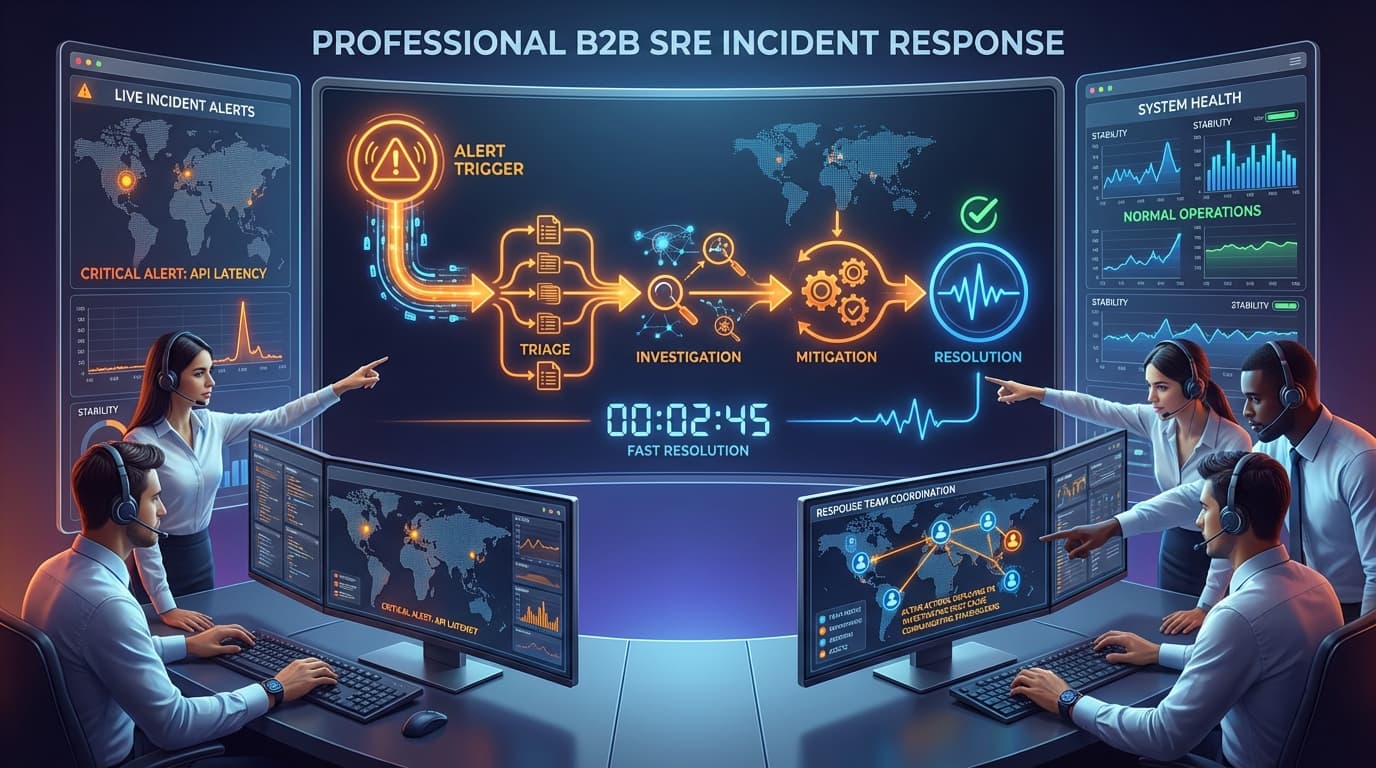
It is 2 AM. Your phone buzzes with a critical alert. You stumble to your laptop, wait for VPN to connect, and spend twenty minutes trying to figure out what is actually broken. By the time you understand the problem, customers have been affected for an hour. This is not an incident response failure—it is an incident response design failure.
Why Most Incident Response Fails
Organizations invest heavily in incident management tools and ITIL processes, yet mean time to resolution (MTTR) remains stubbornly high. The problem is that most incident processes are designed for documentation and compliance, not for speed.
The goal of incident response is not to follow a process perfectly. It is to restore service as fast as possible.
Effective incident response optimizes for three things: detection speed, diagnosis speed, and resolution speed. Everything else is secondary.
Phase 1: Detection That Matters
You cannot fix what you do not know is broken. But alert fatigue kills detection faster than missing alerts. The key is actionable alerting.
Alert design principles:
- Alert on symptoms, not causes: Users cannot log in (symptom) matters more than CPU at 90% (cause)
- Every alert requires action: If you would not wake someone up for it, it is not an alert
- Include context: Dashboards, runbook links, recent changes—in the alert itself
- Deduplicate aggressively: One incident, one alert, not fifty variations
The on-call experience:
Your on-call engineers should be able to understand an alert within 30 seconds of opening it. If they need to hunt for context, your alerting has failed. Build alerts that answer: What is broken? Who is affected? What should I look at first?
Phase 2: Rapid Diagnosis
The gap between "we know something is wrong" and "we know what is wrong" is where incidents drag on. Reduce this gap with preparation, not improvisation.
Runbooks that actually help:
- Start with symptoms: "Users report slow page loads" not "Database troubleshooting"
- Decision trees: Guide the responder through diagnosis with yes/no questions
- Include commands: Copy-paste ready, not "check the logs"
- Keep them current: Outdated runbooks are worse than none
Observability for incident response:
Your observability stack should let responders answer questions quickly:
- What changed recently? (deployments, config changes, traffic patterns)
- Where is the request spending time? (distributed traces)
- What errors are occurring? (logs filtered by time and correlation ID)
- Is this affecting everyone or specific segments? (metrics by region, customer, feature)
Phase 3: Resolution and Recovery
Once you know what is wrong, fix it fast. This means having safe, well-practiced remediation options.
The remediation hierarchy:
- Rollback: If a recent change caused the issue, revert it
- Restart: Many issues resolve with a service restart
- Scale: If load is the problem, add capacity
- Failover: Switch to backup systems or regions
- Workaround: Feature flag, redirect, or disable the affected component
- Fix forward: Deploy a fix (last resort during incidents)
Notice that "deploy new code" is last. During an incident, you want safe, reversible actions. New code introduces new risk.
Communication during incidents:
Stakeholders need updates. Customers need status pages. But communication should not slow resolution. Designate a communications lead separate from the technical responder. Use templates. Automate status page updates where possible.
The Incident Commander Role
For serious incidents, one person should coordinate—not fix—the response. The incident commander:
- Maintains situational awareness across all responders
- Makes decisions about escalation and resource allocation
- Ensures communication happens without interrupting technical work
- Tracks time and calls for help before responders burn out
The IC does not need to be the most senior engineer. They need to stay calm, communicate clearly, and resist the urge to dive into technical work.
Post-Incident: Learning, Not Blaming
Every incident is a learning opportunity—if you approach it right. Blameless post-mortems focus on systems, not individuals.
Effective post-mortem structure:
- Timeline: What happened, when? Build a shared understanding of events
- Impact: Who was affected and how? Quantify when possible
- Root cause: Why did this happen? Use "5 whys" to go deeper
- Contributing factors: What made detection or resolution slower?
- Action items: Specific, assigned, time-bound improvements
Actually follow through:
Post-mortems are worthless if action items sit in a backlog forever. Track completion. Prioritize items that prevent recurrence. Make post-mortem reviews part of team rituals.
Building Incident Response Muscle
You cannot get good at incident response without practice. But you do not want to practice on real incidents.
Game days and chaos engineering:
- Scheduled game days: Inject failures during business hours with the team ready
- Chaos engineering: Controlled experiments in production to find weaknesses
- Tabletop exercises: Walk through scenarios without actually breaking things
On-call onboarding:
New engineers should shadow on-call before taking primary responsibility. They should handle simulated incidents. They should know where to find runbooks, dashboards, and help.
Metrics That Matter
Track these to know if your incident response is improving:
- MTTD (Mean Time to Detect): How long until you know about an incident?
- MTTA (Mean Time to Acknowledge): How long until a human is working on it?
- MTTR (Mean Time to Resolve): How long until service is restored?
- Incident frequency: Are the same types of incidents recurring?
- Customer impact duration: How long were customers actually affected?
DACH Considerations
German enterprises often have additional requirements:
- Works council involvement: On-call policies may require works council approval
- Documentation requirements: Regulated industries need thorough incident records
- Language: Runbooks and communication may need German versions
- Working time regulations: On-call compensation and rest periods are legally defined
Start Improving Today
You do not need to rebuild your entire incident process. Start with these high-impact changes:
- Audit your alerts: Delete or demote alerts that do not require immediate action
- Add context to alerts: Dashboard links, recent changes, basic troubleshooting
- Write one runbook: For your most common or most impactful incident type
- Practice one scenario: Run a tabletop exercise for a realistic failure
- Measure MTTR: You cannot improve what you do not measure
The best incident response is invisible. Users do not know there was a problem because you detected, diagnosed, and resolved it before they noticed. That does not happen by accident—it happens by design.