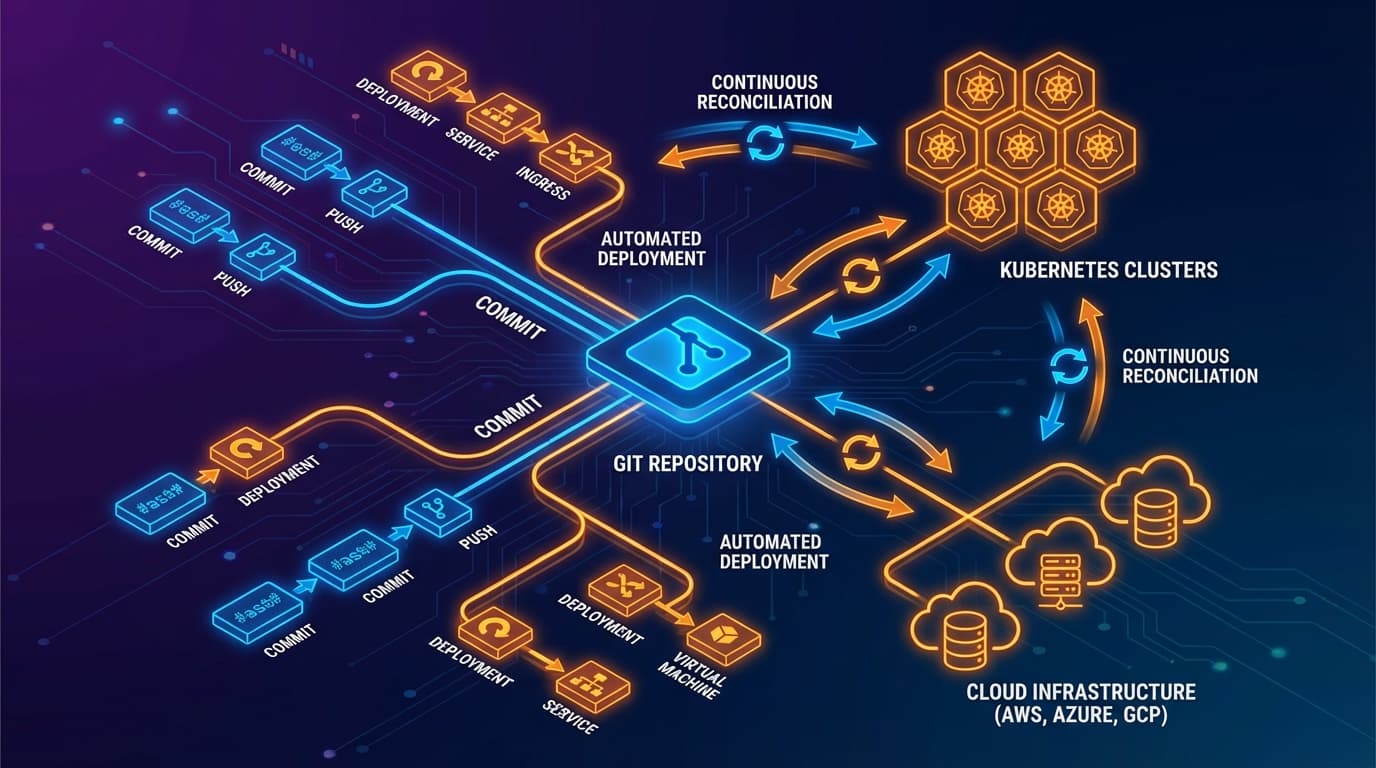
What if your entire infrastructure was defined in Git, automatically synced, and self-healing? That's the promise of GitOps—and for organizations that adopt it, it's transforming how they deploy and manage systems.
What Is GitOps?
GitOps is an operational framework that uses Git as the single source of truth for declarative infrastructure and applications. Instead of manually running commands or clicking through consoles, you make changes via pull requests. Automated agents ensure reality matches what's defined in Git.
The Four Principles of GitOps
1. Declarative Configuration
Your entire system—applications, infrastructure, policies—is described declaratively. You define the desired state, not the steps to get there.
2. Version Controlled
Everything is stored in Git. This gives you history, audit trails, the ability to rollback, and collaboration through pull requests.
3. Automatically Applied
Changes approved in Git are automatically deployed. No manual kubectl commands, no SSH-ing into servers, no clicking through cloud consoles.
4. Continuously Reconciled
Software agents constantly compare the desired state (Git) with the actual state (cluster). Drift is automatically corrected. Self-healing is built-in.
Why GitOps Matters
GitOps delivers tangible benefits:
- Faster deployments: From hours to minutes, with confidence
- Easier rollbacks: Revert a git commit to undo changes
- Better security: No direct cluster access needed, all changes audited
- Improved reliability: Automatic drift correction prevents configuration drift
- Developer experience: Deploy through familiar Git workflows
GitOps Tools
The two most popular GitOps tools are:
- Argo CD: A declarative, Kubernetes-native continuous delivery tool with a powerful UI
- Flux: A set of continuous delivery solutions that are open and extensible
Both are CNCF projects with strong community support.
Getting Started with GitOps
- Start with a single application: Don't try to convert everything at once
- Structure your repositories: Separate app code from configuration
- Implement proper secrets management: Use Sealed Secrets, SOPS, or external secrets operators
- Define your promotion flow: How do changes move from dev to staging to production?
- Set up notifications: Know when syncs succeed or fail
Common Pitfalls to Avoid
- Secrets in Git: Never commit unencrypted secrets, even to private repos
- Missing RBAC: Not everyone should be able to approve production changes
- Ignoring drift alerts: Investigate why drift happens, don't just let it auto-correct
- Over-complicating structure: Start simple, add complexity only when needed
Is GitOps Right for You?
GitOps works best for organizations that:
- Run Kubernetes or similar declarative infrastructure
- Have multiple environments (dev, staging, production)
- Want to improve deployment velocity and reliability
- Value audit trails and compliance
Ready to explore GitOps for your infrastructure? Our team can help you design and implement a GitOps workflow that fits your needs.