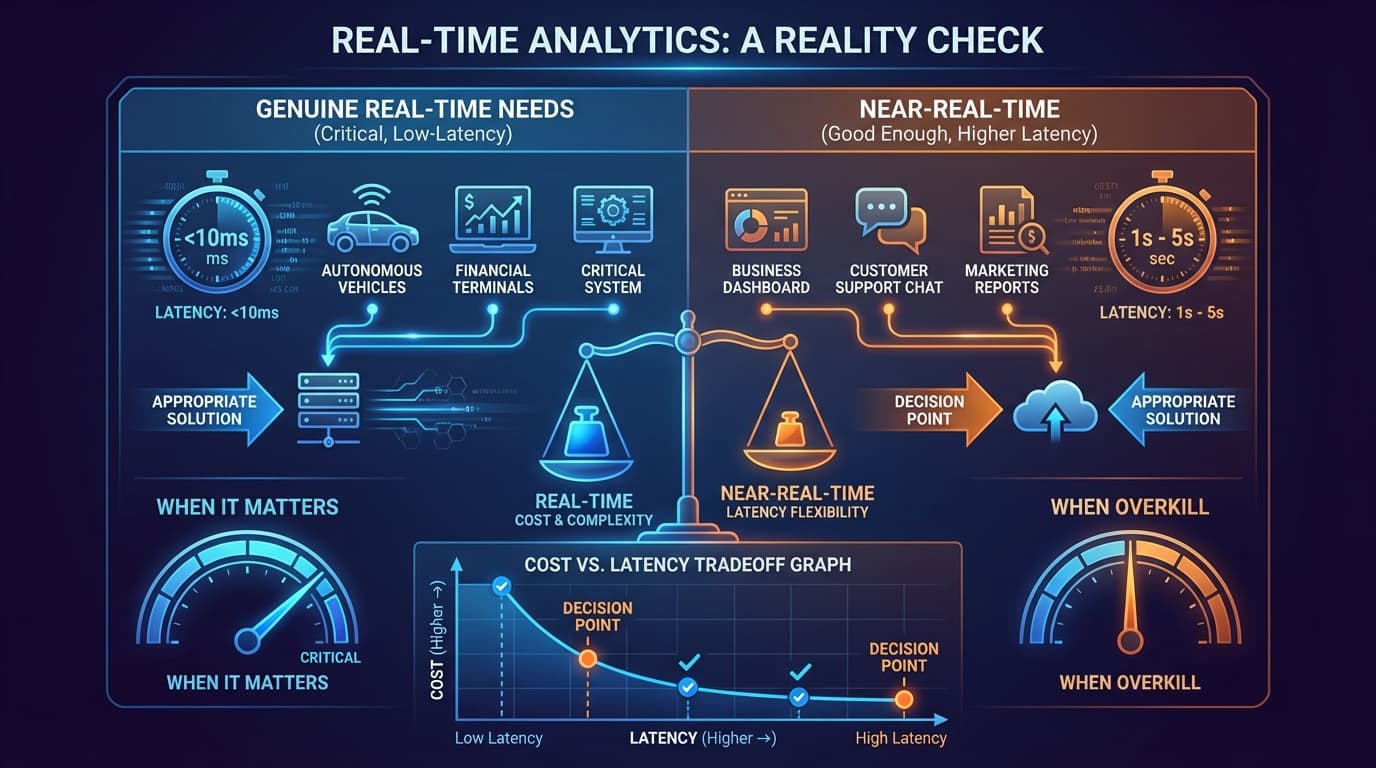
Every executive wants real-time analytics. The vision is compelling: dashboards that update instantly, decisions made with current data, competitive advantage through speed. But here's the uncomfortable truth—most organizations that think they need real-time analytics actually need something much simpler: faster batch processing.
Real-time analytics is expensive, complex, and often overkill. This article helps you distinguish genuine real-time requirements from inflated expectations, and choose the right approach for your actual needs.
Defining Real-Time
The term "real-time" is dangerously ambiguous. Let's be precise:
- True real-time: Millisecond to second latency. Required for fraud detection, trading systems, or operational control systems.
- Near real-time: Seconds to minutes. Suitable for dashboards, alerting, and most operational analytics.
- Micro-batch: Minutes to an hour. Works for most "I want current data" requirements.
- Batch: Hours to daily. Still appropriate for many reporting and analytical use cases.
When someone says they need real-time, the first question is: what decision changes if you get the data 15 minutes later?
The Cost of Real-Time
Real-time isn't just a faster version of batch. It's a fundamentally different architecture with different trade-offs:
Technical Complexity
- Streaming infrastructure: Kafka, Pulsar, or cloud event hubs add operational burden
- Processing frameworks: Flink, Spark Streaming, or ksqlDB require specialized skills
- State management: Handling late arrivals, out-of-order events, and exactly-once semantics is hard
- Debugging: Distributed streaming systems are notoriously difficult to troubleshoot
Operational Overhead
- 24/7 monitoring: Streaming systems don't wait for business hours to fail
- Capacity planning: Peak loads can overwhelm streaming infrastructure
- Data quality: Real-time means less time to validate and clean data
Cost
- Infrastructure: Streaming platforms and always-on compute cost more than batch
- Skills: Streaming expertise commands premium salaries
- Maintenance: Higher ongoing operational costs
Signs You Actually Need Real-Time
Some use cases genuinely require real-time processing:
Fraud Detection
A fraudulent transaction must be blocked in milliseconds, before it completes. Batch processing that catches fraud after the fact is damage control, not prevention.
Operational Control Systems
Manufacturing execution systems, logistics routing, and infrastructure monitoring need current state to make effective decisions. A 15-minute delay could mean production line stoppage or missed SLAs.
Real-Time Personalization
If you're adjusting offers, recommendations, or content based on in-session behavior, you need the data before the session ends.
Alerting on Critical Events
Security incidents, system failures, and threshold breaches need immediate attention. A 30-minute delay in a security alert is unacceptable.
Signs You Need Faster Batch, Not Real-Time
Most "real-time" requirements fall into this category:
Executive Dashboards
Does anyone make a different decision because revenue is updated every second instead of every hour? Usually not. The urgency is psychological, not operational.
End-of-Day Reporting
If reports are reviewed once daily, real-time updates during the day add no value. A 6 AM batch refresh serves the same purpose at lower cost.
Trend Analysis
Analyzing trends requires historical context. Real-time individual data points don't change trend analysis—you still need the full picture.
"Current State" Requirements
Often, "I need current data" means "I need today's data, not yesterday's." That's a batch problem, not a streaming problem.
The Right Architecture for Your Needs
For Genuine Real-Time Requirements
Invest in proper streaming architecture:
- Event-driven ingestion with Kafka or equivalent
- Stream processing with Flink or Spark Streaming
- Real-time serving layer for queries
- Comprehensive monitoring and alerting
For Near Real-Time and Micro-Batch
Consider simpler approaches:
- Frequent batch jobs (every 5-15 minutes)
- CDC (Change Data Capture) for database replication
- Incremental refresh in cloud data warehouses
- Materialized views with frequent refresh
For Batch with Perception of Real-Time
Sometimes the solution is better UX, not faster data:
- Clear timestamps showing data freshness
- Refresh-on-demand buttons for users who need current data
- SLA-based batch jobs that guarantee morning freshness
Questions to Ask Before Going Real-Time
- What specific decision requires real-time data?
- What is the cost of that decision being delayed by 15 minutes? An hour?
- Who is the user, and when do they consume this data?
- Do we have the skills to build and operate streaming infrastructure?
- Can we achieve the goal with faster batch processing instead?
A Pragmatic Approach
Start with the simplest architecture that meets your actual needs. If hourly batch works, use it. If you need faster, try micro-batch before jumping to streaming. Reserve true real-time for the use cases that genuinely require it.
Need help assessing your real-time analytics requirements? Our team helps DACH enterprises distinguish real requirements from inflated expectations, and design architectures that balance capability with pragmatism.