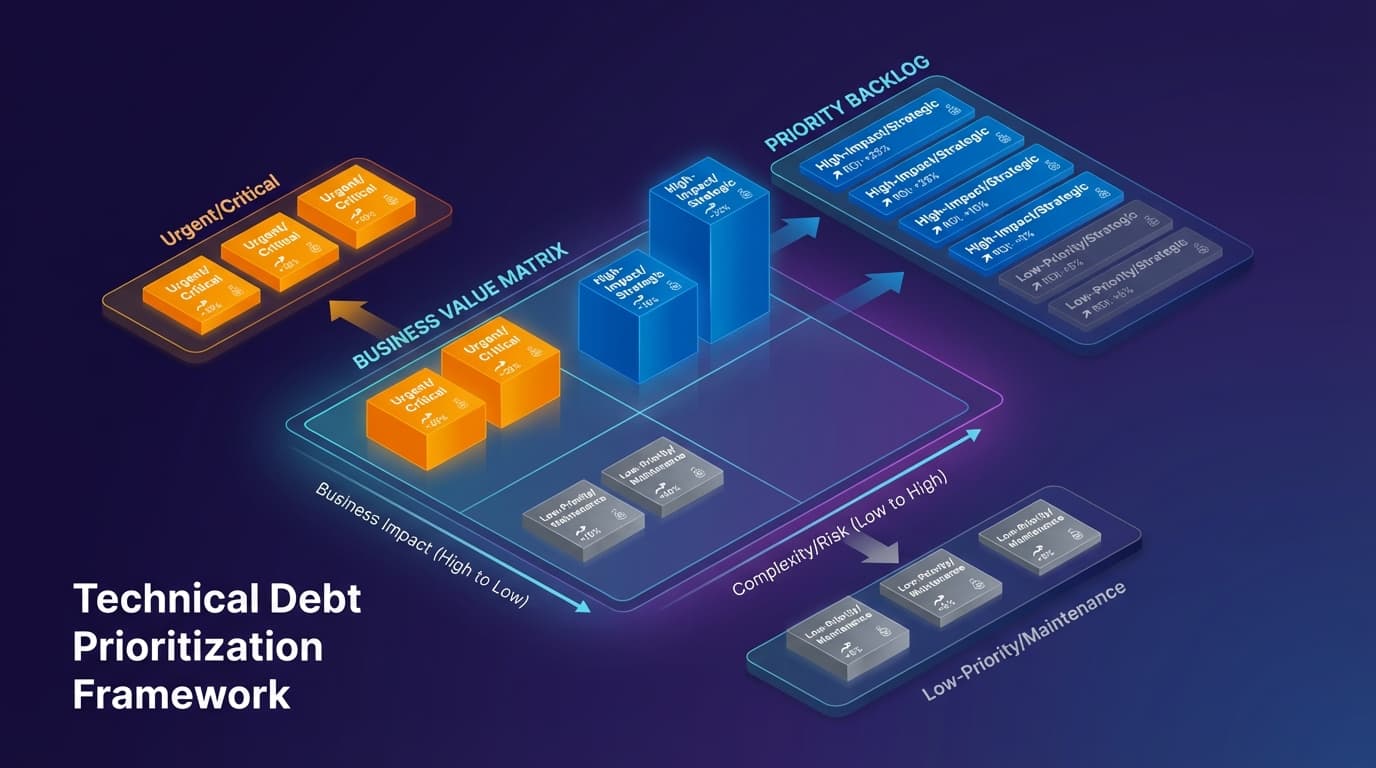
Every engineering team has more technical debt than capacity to address it. The backlog of things we "should" fix grows endlessly: outdated dependencies, inconsistent patterns, missing tests, coupled modules, deprecated frameworks. But here is the uncomfortable truth: most technical debt does not matter. The challenge is identifying which debt is actually hurting the business—and that requires thinking like a CFO, not just an engineer.
The Problem with Engineering-Driven Prioritization
Left to their own devices, engineers prioritize technical debt by what bothers them most. The ugliest code, the most annoying framework, the pattern that offends their sensibilities. But engineering annoyance does not correlate with business impact.
Consider: that poorly structured module might be ugly, but if it works reliably and rarely changes, is fixing it worth the opportunity cost? Meanwhile, the "clean" service with good architecture might be blocking business initiatives because it cannot scale.
Technical debt is only worth paying when the interest payments exceed the cost of repayment. Everything else is premature optimization.
The Business Value Framework for Technical Debt
To prioritize technical debt effectively, evaluate each item across four dimensions:
Dimension 1: Velocity Impact
How much does this debt slow down development of business-critical features?
- High impact: Cannot deliver new features without addressing this first
- Medium impact: Slows development by 20-50% in affected areas
- Low impact: Minor inconvenience, workarounds exist
- None: Code is stable, rarely touched
Key question: How many developer-hours per month does this debt cost us?
Dimension 2: Defect Risk
How likely is this debt to cause production incidents?
- High risk: Known failure modes that will eventually trigger
- Medium risk: Fragile code with history of incidents
- Low risk: Suboptimal but stable
- Minimal: Never caused issues despite imperfect design
Key question: What is the expected cost of incidents caused by this debt?
Dimension 3: Business Opportunity Cost
What business initiatives cannot proceed because of this debt?
- Blocking: Major revenue or strategic initiative blocked
- Delaying: Important initiative progressing slowly
- Constraining: Limits options but not blocking specifics
- None: No business initiative affected
Key question: What is the revenue or strategic value of initiatives this debt blocks?
Dimension 4: Scaling Constraint
Does this debt limit system scalability as business grows?
- Critical: Will hit hard limits within 6 months at current growth
- Significant: Will constrain within 12-18 months
- Minor: May become relevant in 2+ years
- None: Not on scaling path
Key question: When will this debt prevent us from serving customer demand?
The Prioritization Matrix
Score each technical debt item 1-4 on each dimension. Multiply scores to get a priority number. Higher numbers = higher priority for business.
Example Scoring
| Legacy payment integration | 4 (blocking) | 3 | 4 | 3 | =144 |
| Inconsistent API naming | 2 | 1 | 1 | 1 | =2 |
| Monolithic database | 2 | 2 | 3 | 4 | =48 |
| Missing unit tests in module X | 1 | 3 | 1 | 1 | =3 |
The legacy payment integration (score 144) should be prioritized over the "ugly" API naming (score 2), even if engineers find the naming more annoying day-to-day.
Categorizing Your Debt Portfolio
Once scored, technical debt falls into categories:
Pay Now (Score 50+)
High-impact debt that is actively hurting business outcomes. Allocate dedicated sprint capacity. Track as strategic initiative.
Pay Incrementally (Score 20-50)
Significant debt worth addressing as part of related feature work. The "boy scout rule"—leave code better than you found it, focused on high-value areas.
Accept (Score 5-20)
Real debt, but repayment cost exceeds interest. Document the debt, revisit periodically, but do not invest in fixing.
Ignore (Score under 5)
Technical imperfection that is not actually debt because it costs nothing. Remove from the backlog entirely.
The Technical Debt Budget
High-performing teams allocate explicit capacity for technical debt:
- 20% rule: Reserve 20% of sprint capacity for technical improvement
- Tech debt sprints: Periodic sprints focused entirely on debt reduction
- Feature tax: Every feature includes time to clean up adjacent technical debt
Without explicit allocation, urgent feature requests always crowd out important debt repayment.
Measuring Debt Reduction
Track technical debt reduction with metrics that matter to the business:
- Lead time: How long from commit to production? Should improve as debt decreases
- Deployment frequency: How often can you deploy? Technical debt often blocks frequent deployment
- Change failure rate: What percentage of changes cause incidents? High rates indicate quality debt
- Mean time to recovery: How long to recover from incidents? Debt in operations and observability shows here
These DORA metrics connect technical debt reduction to outcomes leadership cares about.
Communicating with Stakeholders
Engineers often struggle to justify technical debt investment to business stakeholders. The framework provides vocabulary:
- Instead of: "We need to refactor this module because it is messy"
- Say: "This module is blocking our ability to deliver the customer portal initiative. Refactoring will reduce the portal timeline by 3 months."
- Instead of: "We should upgrade to the latest framework version"
- Say: "The current framework version has known security vulnerabilities and will reach end-of-life in 6 months, creating compliance risk."
Business impact language gets budget. Engineering aesthetics language does not.
The Technical Debt Register
Maintain a living document of technical debt with:
- Description: What is the debt?
- Impact scores: Velocity, defect risk, opportunity cost, scaling
- Total score: Priority ranking
- Estimated effort: How long to fix?
- Owner: Who is responsible for this area?
- Status: Accepted, in progress, resolved
- Last reviewed: When was this assessment updated?
Review the register quarterly. Scores change as business priorities shift and systems evolve.
Common Prioritization Mistakes
Mistake 1: Treating All Debt as Equal
A 10,000-item technical debt backlog is useless. Most items do not matter. Ruthlessly prune to the 50-100 that have business impact.
Mistake 2: Prioritizing by Engineering Interest
The most interesting technical challenges are rarely the most valuable to fix. Use business impact, not engineering curiosity, as the filter.
Mistake 3: Big Bang Debt Repayment
"We will stop feature development for 3 months to pay down debt" rarely works. Incremental, continuous debt reduction is more sustainable.
Mistake 4: Ignoring Debt in Planning
If technical debt is not visible in planning conversations, it will not get capacity. Make debt explicit alongside feature work.
Getting Started
You do not need to score every piece of technical debt to start. Begin with:
- List the top 20 pieces of technical debt your team complains about
- Score each on the four dimensions
- Sort by total score
- Commit to addressing the top 3-5 in the next quarter
- Measure the business impact of the improvements
The goal is not a perfect inventory—it is making better decisions about where to invest limited technical capacity.
Need help assessing and prioritizing your technical debt portfolio? Our assessment connects technical debt to business outcomes, creating a roadmap that engineering and leadership can align on.