How many applications does your enterprise run? If you do not know the exact number, you are not alone—most CTOs cannot answer this question with confidence. And here is the uncomfortable truth: whatever number you think it is, it is probably higher. Research shows that the average enterprise maintains 3-5x more applications than they actually need. That is waste you can eliminate—if you have a systematic approach.
The Hidden Cost of Application Sprawl
Every application in your portfolio carries costs, even if it looks cheap:
- Licensing: Even "free" open source has support and maintenance costs
- Infrastructure: Servers, storage, networking, cloud resources
- Integration: Every application touch point requires maintenance
- Security: Each application is an attack surface that needs patching and monitoring
- Knowledge: Someone must understand each system
- Opportunity cost: Resources spent maintaining applications cannot innovate
The cheapest application is the one you do not run. Every application rationalized is a permanent cost reduction.
The TIME Framework
Application portfolio rationalization starts with categorization. The TIME framework provides a structured approach:
T - Tolerate
Applications that meet business needs adequately but are not strategic. They work, they are stable, and changing them would cost more than keeping them.
- Action: Minimize investment, maintain only for stability
- Investment: Bug fixes and security patches only
- Typical percentage: 20-30% of portfolio
I - Invest
Strategic applications that provide competitive advantage. These deserve enhancement and modernization investment.
- Action: Active development, modernization, feature investment
- Investment: New features, performance improvements, modern architecture
- Typical percentage: 15-25% of portfolio
M - Migrate
Applications that need to move to new platforms, consolidate with other systems, or be replaced with modern alternatives.
- Action: Plan migration, build business case, execute transition
- Investment: Migration projects with defined end dates
- Typical percentage: 20-30% of portfolio
E - Eliminate
Applications that provide minimal value, duplicate other capabilities, or serve obsolete business processes.
- Action: Decommission with planned sunset
- Investment: Minimal—only what is needed to safely retire
- Typical percentage: 20-40% of portfolio
The Rationalization Process
Phase 1: Discovery (4-8 weeks)
Before rationalizing, you must know what you have. This phase builds your application inventory:
- Automated discovery: Network scans, cloud inventory APIs, license management data
- Manual enrichment: Business owner identification, usage patterns, integration mapping
- Shadow IT surfacing: SaaS subscriptions, departmental applications, citizen development
The goal is a complete inventory with owner, function, technology stack, cost, and usage for each application.
Phase 2: Assessment (4-6 weeks)
Score each application on two dimensions:
Business Value
- Revenue contribution (direct or supporting)
- Number of active users
- Business process criticality
- Regulatory or compliance requirement
- Strategic alignment
Technical Health
- Technology currency (how modern is the stack?)
- Security posture
- Performance and reliability
- Maintainability and documentation
- Integration complexity
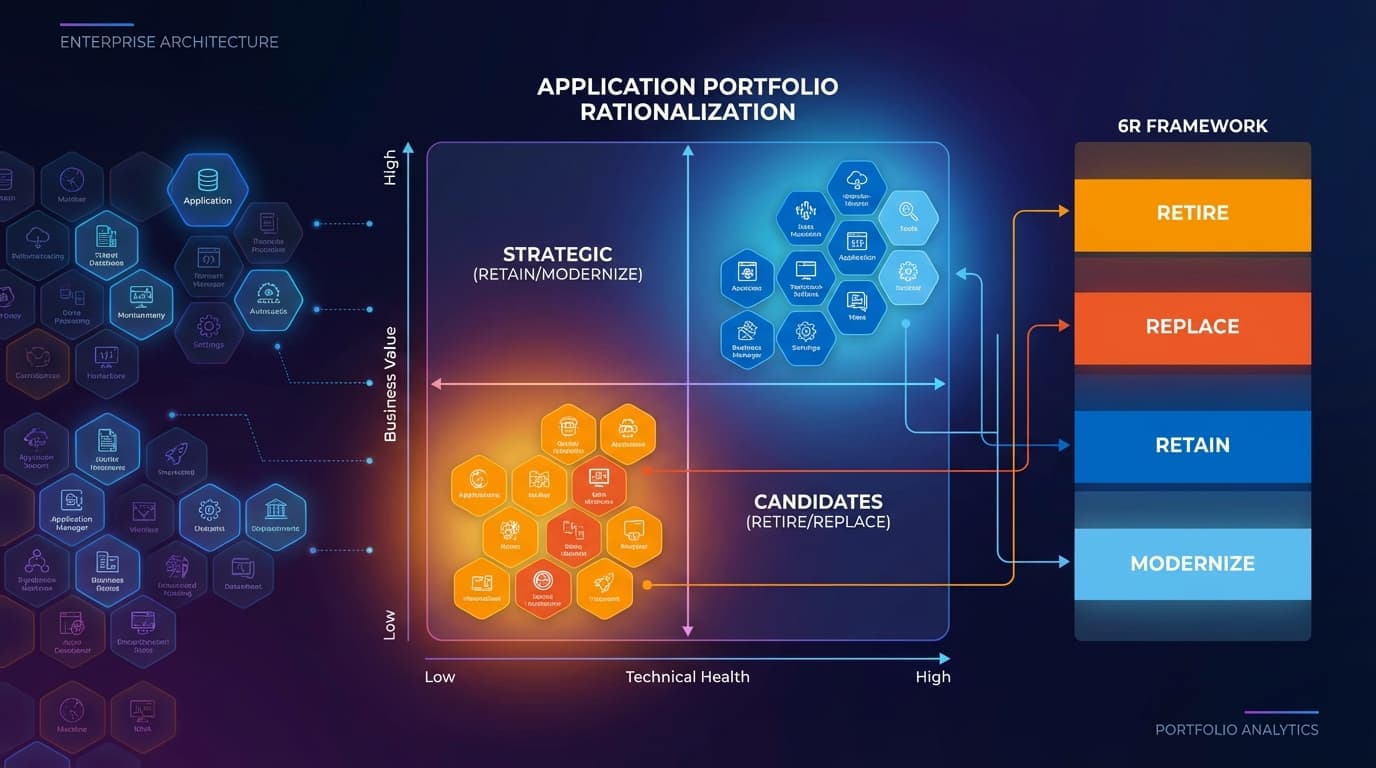
Plot applications on a 2x2 matrix: high/low business value vs. high/low technical health. This visualization drives TIME categorization.
Phase 3: Rationalization Planning (2-4 weeks)
For each application, determine:
- Target disposition: Tolerate, Invest, Migrate, or Eliminate
- Dependency analysis: What other systems depend on this application?
- Migration target: If migrating, where does the capability go?
- Timeline: When will the disposition action complete?
- Resource requirements: What investment is needed?
Phase 4: Execution (ongoing)
Rationalization is not a one-time project—it is an ongoing program:
- Quick wins first: Start with obvious elimination candidates
- Wave planning: Group related applications for coordinated action
- Continuous monitoring: Track progress against plan, adjust as needed
- Portfolio governance: Prevent new sprawl while rationalizing existing
Consolidation Patterns
Beyond elimination, rationalization often involves consolidation:
Functional Consolidation
Multiple applications serving similar functions merge into one. Three different CRM systems become one. Five reporting tools become a unified BI platform.
Technical Consolidation
Applications on obsolete platforms migrate to strategic platforms. Legacy on-premise systems move to cloud. Custom applications replace with SaaS where appropriate.
Data Consolidation
Fragmented data stores consolidate into authoritative sources. Master data management reduces duplication and improves data quality.
The Governance Imperative
Rationalization without governance is temporary. New applications will proliferate, and in three years you will rationalize again. Sustainable results require:
- Architecture review: New applications must justify existence before approval
- Technology standards: Limit approved platforms to prevent new fragmentation
- Business case requirements: Quantified benefits before application acquisition
- Sunset policies: Every application has a planned end-of-life date
- Regular portfolio reviews: Annual assessment keeps the portfolio lean
Change Management Considerations
Rationalization affects people. Users may resist losing "their" applications:
- Stakeholder engagement: Involve business owners early in rationalization decisions
- Clear communication: Explain the "why" behind retirement decisions
- Adequate transition time: Allow time for users to adapt to new systems
- Training investment: Ensure users can work effectively with consolidated systems
Measuring Success
Track rationalization progress with clear metrics:
- Application count: Total applications over time (trending down)
- Technology count: Number of distinct platforms and frameworks
- Cost per application: Total IT spend divided by application count
- Support ticket volume: Should decrease as portfolio simplifies
- Integration points: Reduced complexity in system connections
Common Pitfalls
Pitfall 1: Incomplete Discovery
Shadow IT and departmental applications hide from central IT. If your inventory misses them, your rationalization will too.
Pitfall 2: Political Protection
Some applications survive not because of business value but because of political protection. Executive sponsorship for rationalization helps overcome resistance.
Pitfall 3: Underestimating Dependencies
Retiring an application that other systems depend on creates cascading problems. Map dependencies thoroughly before elimination.
Pitfall 4: One-Time Thinking
Without ongoing governance, application sprawl returns. Treat rationalization as a continuous program, not a project.
Getting Started
You do not need to rationalize everything at once. Start with a subset—a single business unit, a specific technology platform, or a particular application category. Demonstrate value, build momentum, then expand.
Our portfolio assessment provides the discovery, analysis, and planning you need to begin. We help you build the inventory, assess each application, and create a prioritized rationalization roadmap.
Every application you eliminate is a permanent cost reduction and a simplification that makes everything else easier. Ready to streamline your portfolio?