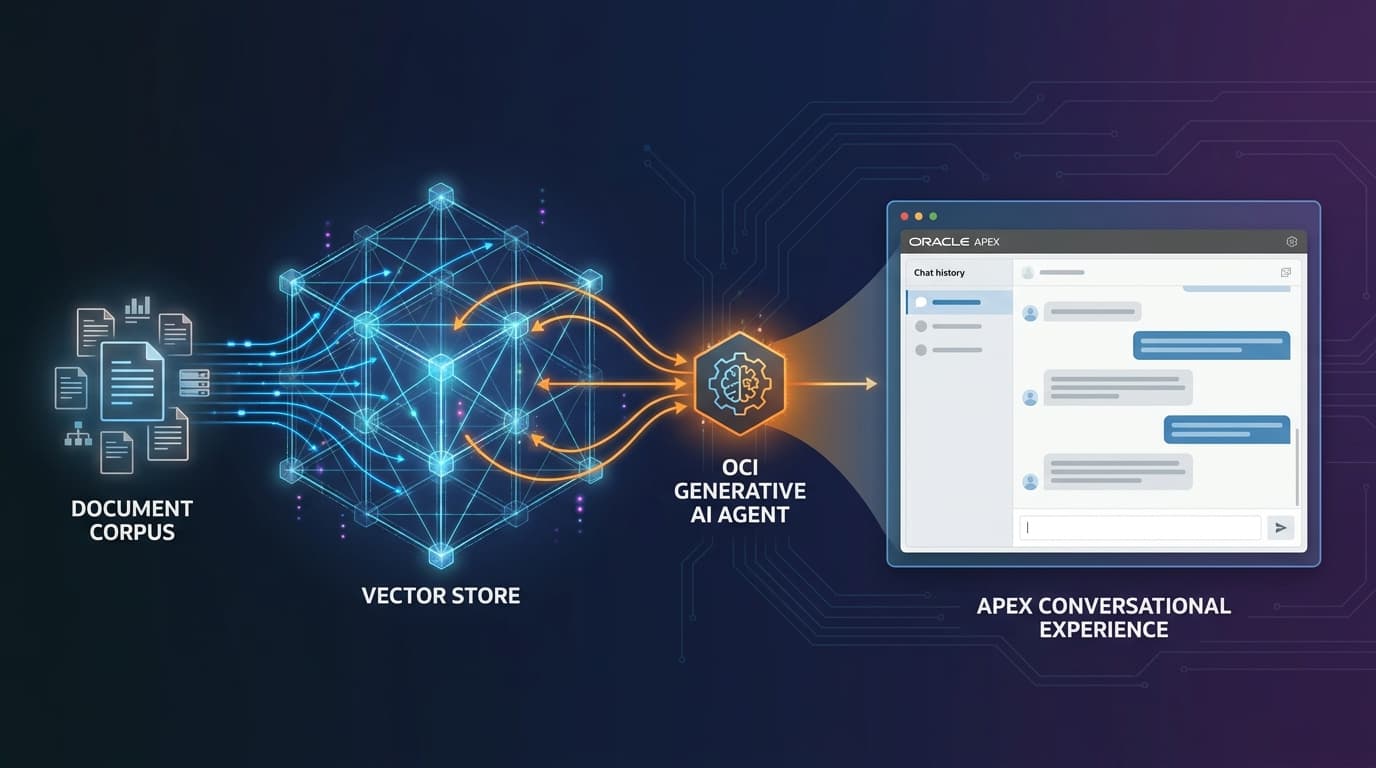
APEX 26.1 brings agentic capability inside the application. Most useful enterprise questions, though, span more than one application — and more than just structured data. The right architecture for "answer my question from across our internal documents" is not a bigger APEX agent. It is OCI Generative AI Agents, with APEX as the front door. This post is the practical pattern for connecting the two.
What OCI Generative AI Agents actually do
OCI Generative AI Agents is a managed service from Oracle that handles the heavy lifting of a Retrieval-Augmented Generation pipeline: document ingestion, chunking, embedding, vector storage, retrieval, prompt construction, and LLM invocation. You point it at a content source — Object Storage bucket of PDFs, an OCI Search index, a database table of curated knowledge — and the service exposes a chat-style endpoint that answers questions grounded in those documents.
The selling point is not the AI itself; you can build RAG yourself with off-the-shelf parts. The selling point is that the data path stays inside OCI, the access model integrates with OCI Identity, the audit story is the same as for any other OCI service, and the operational burden of a homegrown RAG stack disappears.
Why APEX wants OCI for this
APEX AI Agents and AI Tools are scoped to an application. The scope is the feature, not a limitation. Cross-application, cross-document, cross-modal questions need a different shape:
- Knowledge that lives in PDFs, contracts, policy documents and SharePoint pages, not in tables.
- Answers that need to cite the source document, paragraph and page.
- A retrieval and embedding model that you do not want to operate yourself.
- An LLM choice that is governed by OCI's data-residency and confidentiality terms.
This is the OCI GenAI Agents lane. APEX is the experience layer.
The integration shape
The architecture is pleasingly simple. From APEX's perspective, OCI GenAI Agents is just another REST endpoint. You wrap it as a single REST AI Tool on your APEX agent, give the tool a clear name (for example askKnowledgeBase), and let the APEX agent decide when to invoke it.
From OCI's perspective, the request is authenticated, the conversation has a session ID, the retrieval happens against the configured content source, and the response includes both the answer and the cited document chunks.
From the user's perspective, they are chatting inside an APEX page that feels like part of their normal application — same login, same theme, same audit, same place they already work.
A concrete example: an HR knowledge assistant
Imagine an HR portal built in APEX. The structured data (employee records, time tracking, vacation balances) lives in tables your APEX agent can answer from directly. But employees also ask questions like:
- "What is the policy on parental leave for a second child?"
- "How much notice do I owe if I want to resign on December 15?"
- "Is the company-car policy different for senior managers?"
These answers live in PDFs in a controlled folder, drafted by HR, reviewed by legal, updated quarterly. They do not belong in tables. The right architecture is:
- HR uploads the latest policy PDFs to an OCI Object Storage bucket.
- An OCI GenAI Agent is configured against that bucket as its content source.
- The APEX HR application has an AI Agent with two tools: employeeRecordLookup (PL/SQL, internal) and askPolicyKnowledgeBase (REST, calls OCI GenAI Agents).
- The APEX agent's instructions say: "Use employeeRecordLookup for questions about the user's own records; use askPolicyKnowledgeBase for questions about policy."
- The user gets one chat experience; the agent quietly routes the right tool for the right question.
Every cited answer comes back with the source PDF and paragraph, so the employee can verify. Every retrieval is logged. Every policy update is just a new PDF in the bucket — no model retraining, no developer change.
What this avoids
It is worth listing what this architecture does not require. No homegrown vector database to operate. No embedding-pipeline cron jobs to debug. No "did anyone notice the model deprecation last quarter" surprises. No data leaving OCI to a third-party LLM. No bespoke integration between four moving parts. The integration is one REST call and one application-level tool registration.
The valuable thing about OCI GenAI Agents is not that it is technically novel. It is that it removes the seven worst weeks of a homegrown RAG project.
Where APEX agents still beat OCI agents
Do not over-rotate. APEX AI Agents are still the better answer when:
- The question is answerable from the application's own tables and the user's own permissions.
- The action involves writing data through scoped PL/SQL or REST tools.
- The interaction is short and transactional, not exploratory.
OCI GenAI Agents take over when:
- The corpus is unstructured documents.
- The answer needs to cite passages.
- The conversation may span topics the application's schema cannot represent.
The cleanest production designs use both, and let the APEX agent route between them.
A practical starting plan
- Identify one document corpus that gets repeated questions and whose owners can keep it current. HR policies, IT service catalog, internal compliance handbooks are good first picks.
- Set up an OCI bucket with strict access. Decide who can upload and who can delete.
- Provision an OCI GenAI Agent against that bucket. Test it via the OCI console before involving APEX.
- Add one REST tool to your APEX application's AI Agent, calling the OCI endpoint with a service-principal credential.
- Pilot with one user group. Capture the questions asked, the documents cited, and the answers users marked unhelpful.
- Iterate on the corpus, not the model. Most quality gains come from fixing the underlying documents — clearer titles, better section structure, fewer outdated PDFs.
The architectural point
The pattern that wins for enterprise AI in 2026 is not one giant agent that does everything. It is many narrow agents, each scoped to a domain, composed through clearly named tools. OCI GenAI Agents and APEX 26.1 together let you build that composition without either component leaking into the other. APEX stays the trusted application surface. OCI stays the managed knowledge layer. The user sees one experience. The auditor sees clean boundaries. That is the design that scales.