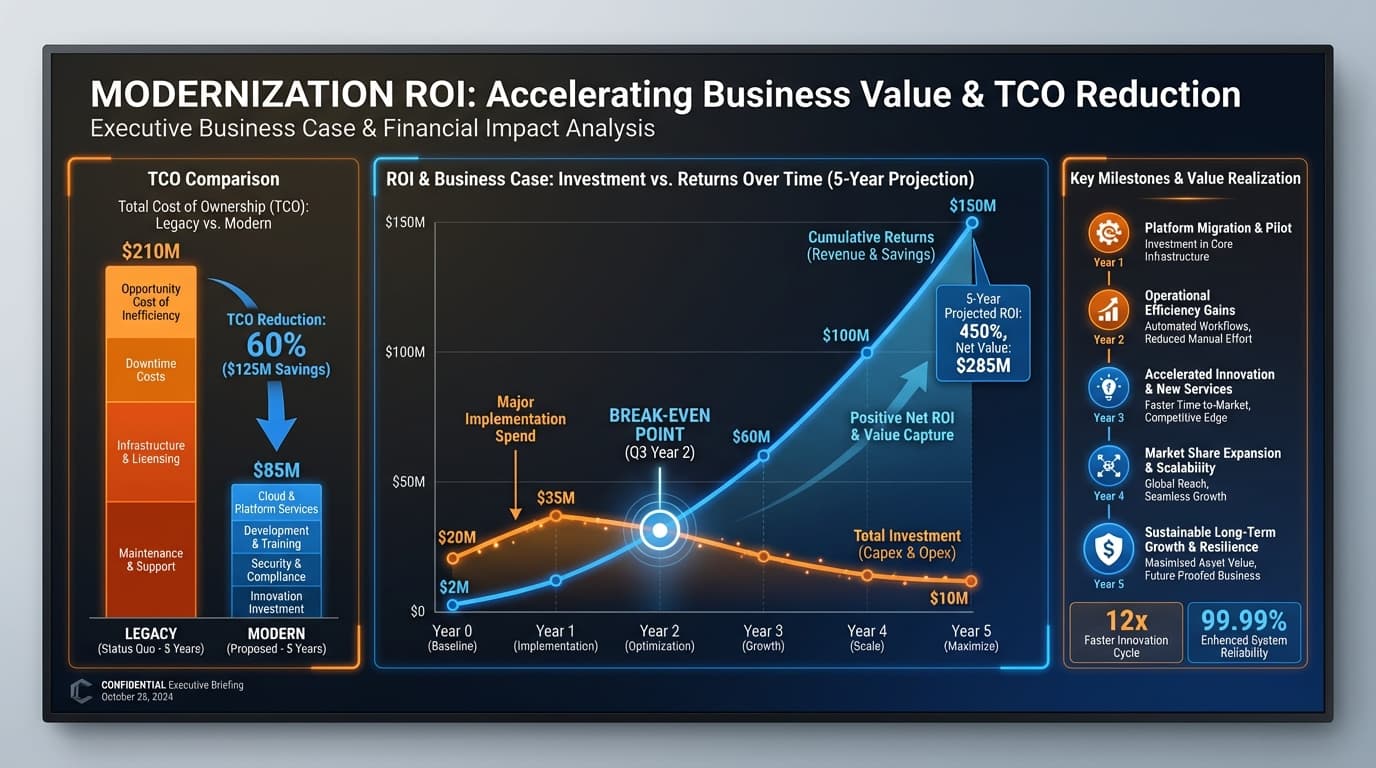
You know your legacy systems need modernization. The technology debt is obvious to anyone who works with the code. But when you present the business case to the CFO or the board, you get polite interest followed by "not this year" or "what else could we invest in instead?" The problem is not your modernization strategy—it is how you are presenting the business case. Boards do not approve technology projects. They approve investments with clear returns.
Why Technology Business Cases Fail
Most modernization proposals fail because they focus on technical benefits:
- "We need to upgrade because the current system is outdated"
- "Modern architecture will be more maintainable"
- "We cannot find developers for this technology anymore"
- "The system is at capacity and cannot scale"
These are all true. They are all valid concerns. And they will not get funded. Why? Because they describe problems, not returns. A CFO comparing investment options needs to know: what does the organization get for this money?
A business case is not about what you need. It is about what the investment returns. Boards approve ROI, not necessity.
The Four Categories of Modernization Returns
Every modernization benefit falls into one of four categories. You need to quantify at least two to build a compelling case.
Category 1: Cost Avoidance
What costs will you avoid by modernizing?
- Licensing: Annual maintenance fees for legacy software
- Infrastructure: Expensive legacy hardware and specialized hosting
- Premium talent: Scarce legacy skills commanding above-market rates
- Support contracts: Extended support for end-of-life systems
- Compliance costs: Manual processes required for non-compliant systems
Example calculation: Oracle Forms developer rates are 150-200 EUR/hour. Modern web developers are 80-120 EUR/hour. If you have 10 FTE-equivalent development capacity, the annual savings from platform shift could be 400,000-600,000 EUR.
Category 2: Productivity Gains
How will modernization increase productivity?
- Development velocity: Features that take weeks on legacy might take days on modern platforms
- Deployment frequency: Modern CI/CD enables daily deployments vs. quarterly releases
- Incident reduction: Better architecture means fewer production issues
- Integration efficiency: Modern APIs vs. custom point-to-point integrations
Example calculation: If deployment cycles reduce from quarterly to weekly, business gets value from features 12x faster. If your development team costs 2M EUR annually, even 20% productivity improvement is 400,000 EUR in value.
Category 3: Revenue Enablement
What revenue opportunities does modernization unlock?
- New markets: Modern platforms can support international expansion
- New products: Digital products built on modern architecture
- Customer experience: Better interfaces increase conversion and retention
- Scalability: Ability to serve growing customer base
Example calculation: If modernization enables a new digital product line projected at 5M EUR revenue in year 3, even discounted, that is significant return on a 2M EUR modernization investment.
Category 4: Risk Mitigation
What risks does modernization reduce?
- Security vulnerabilities: Unsupported software lacks security patches
- Compliance exposure: Legacy systems may not meet GDPR, industry regulations
- Business continuity: Single points of failure in legacy systems
- Key person dependency: When the one person who knows the system leaves
Example calculation: Average cost of a significant data breach in Germany is 4.3M EUR. If legacy systems increase breach probability by 15%, the expected value of risk reduction is 645,000 EUR.
The Board-Ready Business Case Template
Structure your business case to answer the questions decision-makers actually ask:
Section 1: Investment Summary (1 page)
- Total investment required
- Investment timeline (when capital is needed)
- Expected returns by category
- Net present value (NPV) and internal rate of return (IRR)
- Payback period
Section 2: Current State Cost Analysis (2-3 pages)
- Total cost of ownership for current systems
- Breakdown by category (licensing, infrastructure, personnel, support)
- Trend analysis (costs increasing? why?)
- Hidden costs often missed in IT budgets
Section 3: Future State Benefits (2-3 pages)
- Quantified benefits by category
- Timeline for benefit realization
- Assumptions and how they were validated
- Conservative, expected, and optimistic scenarios
Section 4: Investment Requirements (2-3 pages)
- Capital expenditure requirements
- Operational expenditure during transition
- Resource requirements (internal and external)
- Timeline and milestones
Section 5: Risk Analysis (1-2 pages)
- Risks of proceeding with modernization
- Risks of NOT proceeding (often overlooked)
- Mitigation strategies
- Contingency plans
Section 6: Recommendation (1 page)
- Clear investment recommendation
- Decision required from the board
- Next steps if approved
The Financial Metrics That Matter
Learn to speak the language of finance:
Net Present Value (NPV)
Total value of cash flows (positive and negative) discounted to today. Positive NPV means the investment creates value.
Formula: NPV = Sum of (Cash flows / (1 + discount rate)^year) - Initial investment
Typical discount rate: 8-12% for enterprise investments
Internal Rate of Return (IRR)
The discount rate at which NPV equals zero. Higher IRR means better investment.
Benchmark: IRR should exceed your company's cost of capital (typically 10-15%)
Payback Period
How long until cumulative benefits exceed investment.
Benchmark: Most enterprises want payback within 24-36 months for technology investments
Total Cost of Ownership (TCO)
Full lifecycle cost including acquisition, operation, maintenance, and decommissioning.
Key insight: Compare TCO of current state vs. future state, not just modernization cost
Common Calculation Mistakes
Mistake 1: Ignoring Transition Costs
You will run old and new systems in parallel. You will need data migration. You will need training. Include the full transition cost, not just the new system cost.
Mistake 2: Overestimating Immediate Benefits
Benefits ramp up over time. Year 1 benefits are often minimal while transition is in progress. Be realistic about the benefit curve.
Mistake 3: Forgetting Ongoing Costs
Modern systems have costs too: cloud infrastructure, SaaS subscriptions, new skill development. Compare full TCO, not just licensing reduction.
Mistake 4: Single Scenario Planning
Executives distrust single-number forecasts. Provide conservative, expected, and optimistic scenarios with clear assumptions behind each.
The Comparison Framework
Present modernization against alternatives:
- Option 0: Do nothing - What happens if we continue as-is? (Include rising maintenance costs, increasing risk)
- Option 1: Minimal investment - What is the cheapest path that addresses immediate risks?
- Option 2: Full modernization - What is the recommended approach?
- Option 3: Maximum investment - What could we achieve with more aggressive investment?
Boards appreciate options. "Do nothing" is always an option, and showing its cost makes modernization more compelling.
Working with Finance
Before presenting to the board, partner with your CFO or finance team:
- Use their templates and formats
- Get their input on discount rates and financial assumptions
- Have them validate your calculations
- Understand what competing investments the business case will be measured against
A business case endorsed by finance is dramatically more likely to be approved.
After Approval: Proving the Value
The business case does not end at approval. Track and report on promised benefits:
- Establish baseline metrics before modernization
- Measure against projections quarterly
- Report to stakeholders on benefit realization
- Adjust forecasts as you learn more
Delivering on promised ROI builds credibility for future investments.
Getting Started
A compelling business case starts with clear current-state costs. If you do not know your TCO today, you cannot calculate ROI tomorrow.
Our business case development service helps you quantify current costs, project future benefits, and build the board-ready case that gets modernization approved. We have helped DACH enterprises secure investment for transformations ranging from Oracle Forms migration to full mainframe modernization.
Ready to build a business case that speaks the language of finance? Let us help you translate technology necessity into investment return.