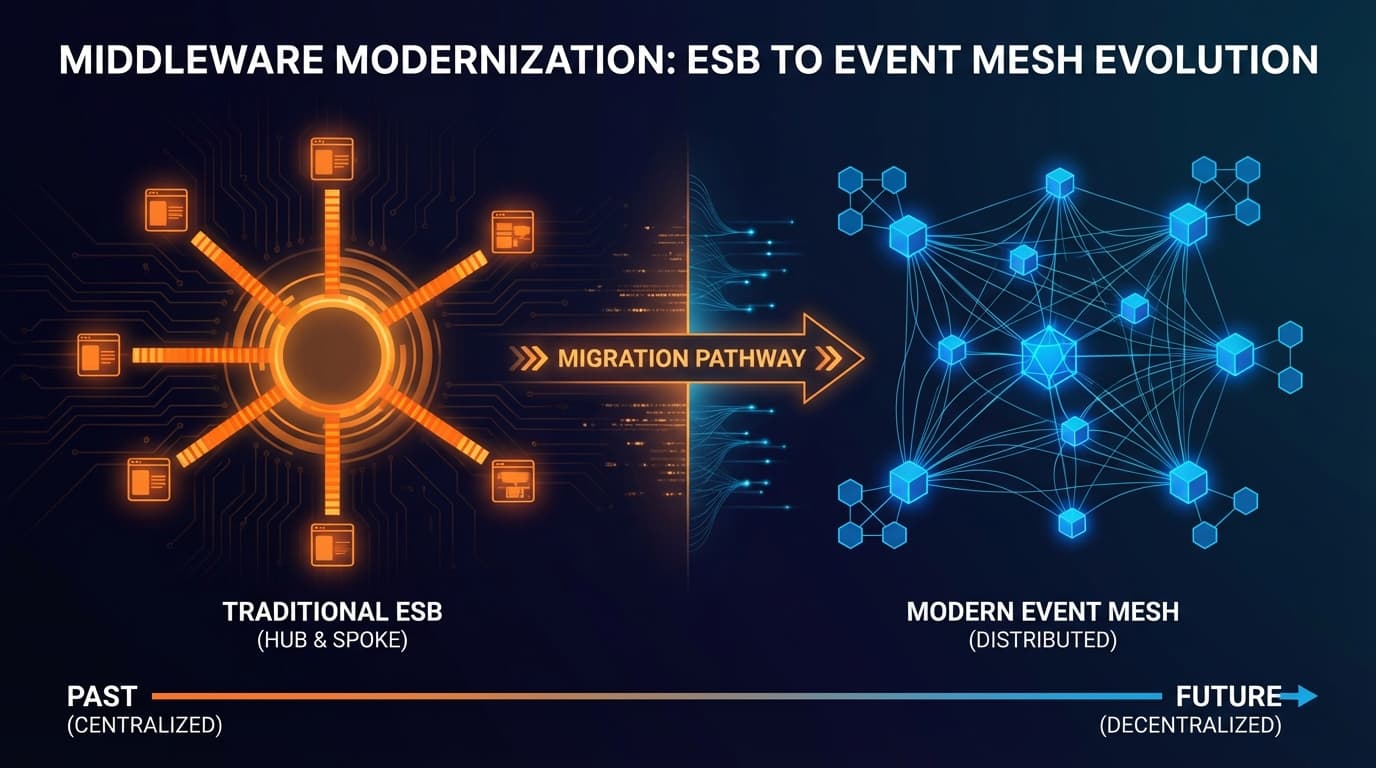
The Enterprise Service Bus (ESB) was the integration answer for a generation of enterprise architects. Centralized, powerful, capable of complex transformations and orchestrations. But the world has changed, and ESBs are showing their age.
Why ESBs Struggle in Modern Environments
The Monolith Problem
ESBs are centralized by design. Every integration passes through them. This creates:
- Single points of failure
- Scaling bottlenecks
- Complex deployment dependencies
- Vendor lock-in (once you're deep in TIBCO or MuleSoft, migration is painful)
Cloud-Native Mismatch
ESBs assume stable, long-running servers. Cloud-native architectures assume ephemeral, auto-scaling containers. These paradigms clash:
- ESB licensing often doesn't fit cloud scaling models
- Stateful ESB patterns conflict with stateless container best practices
- Heavy ESB runtimes don't suit lightweight microservices
Enter the Event Mesh
An event mesh is a distributed network of event brokers that enables event-driven communication across hybrid environments. Unlike ESBs:
- Decentralized: No single point of failure or bottleneck
- Environment-spanning: Works across cloud, on-prem, and edge
- Dynamic: Auto-discovers and routes events without manual configuration
- Protocol-agnostic: Bridges different messaging protocols
Migration Strategy
Phase 1: Assess and Categorize
Inventory your current ESB integrations:
- Simple routing: A-to-B integrations that just move data
- Transformation: Format conversion, field mapping
- Orchestration: Multi-step business processes
- Legacy protocol: Connections to systems requiring specialized protocols
Phase 2: Parallel Run
Don't rip out the ESB. Run the event mesh alongside it:
- New integrations go directly to the event mesh
- Migrate simple routing first—lowest risk, highest volume
- Keep complex orchestrations on ESB until proven patterns exist
Phase 3: Strangler Pattern
Progressively route traffic to the event mesh:
- Mirror traffic to both systems initially
- Compare results to validate correctness
- Shift traffic gradually based on confidence
- Decommission ESB endpoints as they become unused
The goal isn't to replace ESB functionality 1:1—it's to rethink how integrations should work in a modern architecture.
What Changes
Transformation Ownership
In ESBs, the integration layer owns transformations. In event-driven architectures, producers emit canonical events, and consumers handle their own transformations. This distributes the work but requires clear event schemas.
Orchestration Approach
ESB orchestrations become choreography. Instead of a central orchestrator directing steps, services react to events and emit their own. This requires careful design to avoid losing visibility into business processes.
Monitoring and Observability
ESBs provide centralized monitoring. Distributed event meshes require distributed tracing and correlation IDs to track requests across services.
Technology Choices
Event mesh implementations vary:
- Solace: Purpose-built event mesh with broad protocol support
- Confluent: Kafka-based with additional enterprise features
- Cloud-native: AWS EventBridge, Azure Event Grid for cloud-first
The right choice depends on your environment mix, protocol requirements, and team expertise. The important thing is starting the journey—ESBs aren't getting more modern, and your architecture needs to evolve.