For decades, enterprise integration meant point-to-point connections: System A calls System B, waits for a response, processes it, and moves on. This request-response pattern served us well when systems were few and integrations were simple. That era is over.
The Point-to-Point Problem
Modern enterprises run hundreds of applications. Point-to-point integration doesn't scale:
- Exponential complexity: N systems require N×(N-1)/2 potential connections
- Tight coupling: Changes to one system break dependent systems
- Synchronous bottlenecks: Slow downstream systems slow down everything
- Poor fault tolerance: When one system fails, failures cascade
Enter Event-Driven Architecture
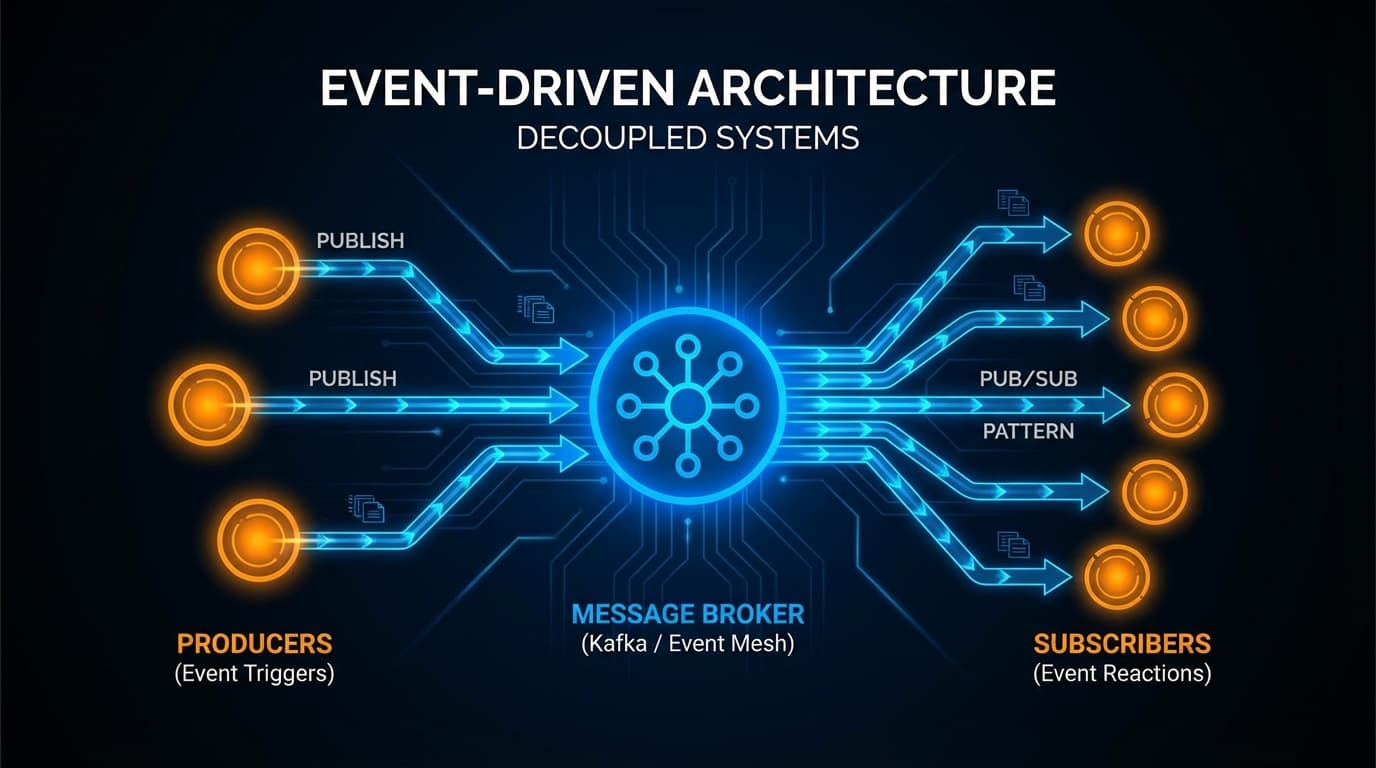
Event-driven architecture (EDA) inverts the integration model. Instead of systems calling each other, systems publish events about what happened. Other systems subscribe to events they care about and react accordingly.
Core Concepts
- Events: Immutable facts about something that happened ("Order Placed," "Payment Received")
- Producers: Systems that generate events
- Consumers: Systems that react to events
- Event broker: Infrastructure that routes events (Kafka, RabbitMQ, Azure Event Hubs)
Why EDA Wins
Loose Coupling
Producers don't know about consumers. When you add a new system, existing systems don't change. When you remove a system, nothing breaks. This dramatically reduces change risk.
Scalability
Each component scales independently. A spike in orders doesn't slow down inventory updates—they process events at their own pace.
Real-Time Processing
Events flow continuously. No more batch processing that makes data stale. Business decisions happen on current information.
Auditability
The event stream becomes an immutable log of everything that happened. Debugging, compliance, and analytics all benefit.
Making the Transition
Shifting to EDA doesn't happen overnight. Here's a practical path:
1. Identify Event-Worthy State Changes
Not everything needs to be an event. Focus on significant business state changes that multiple systems care about. "Order status changed" is an event. "User clicked a button" probably isn't.
2. Start with New Integrations
Don't rip out working point-to-point integrations. Build new integrations event-first. Let the old patterns age out naturally.
3. Choose Your Backbone
Apache Kafka dominates enterprise event streaming, but cloud-native options like Azure Event Hubs or AWS EventBridge reduce operational overhead. Match your choice to your team's capabilities.
4. Design for Event Evolution
Event schemas will change. Build versioning into your event structure from day one. Consumers should handle unknown fields gracefully.
The hardest part of event-driven architecture isn't the technology—it's getting teams to think in events instead of API calls.
Common Pitfalls
- Event soup: Publishing everything creates noise. Be deliberate about what becomes an event.
- Hidden dependencies: Just because coupling is loose doesn't mean it's gone. Document event contracts.
- Eventual consistency confusion: Teams used to immediate consistency struggle with delays. Set expectations early.
- Overcomplicating early: Start simple. You don't need complex event sourcing patterns for every use case.
Event-driven architecture isn't a silver bullet, but for enterprises with complex, evolving integration needs, it's increasingly the right paradigm. The sooner you start building event-first, the sooner you'll see the benefits.