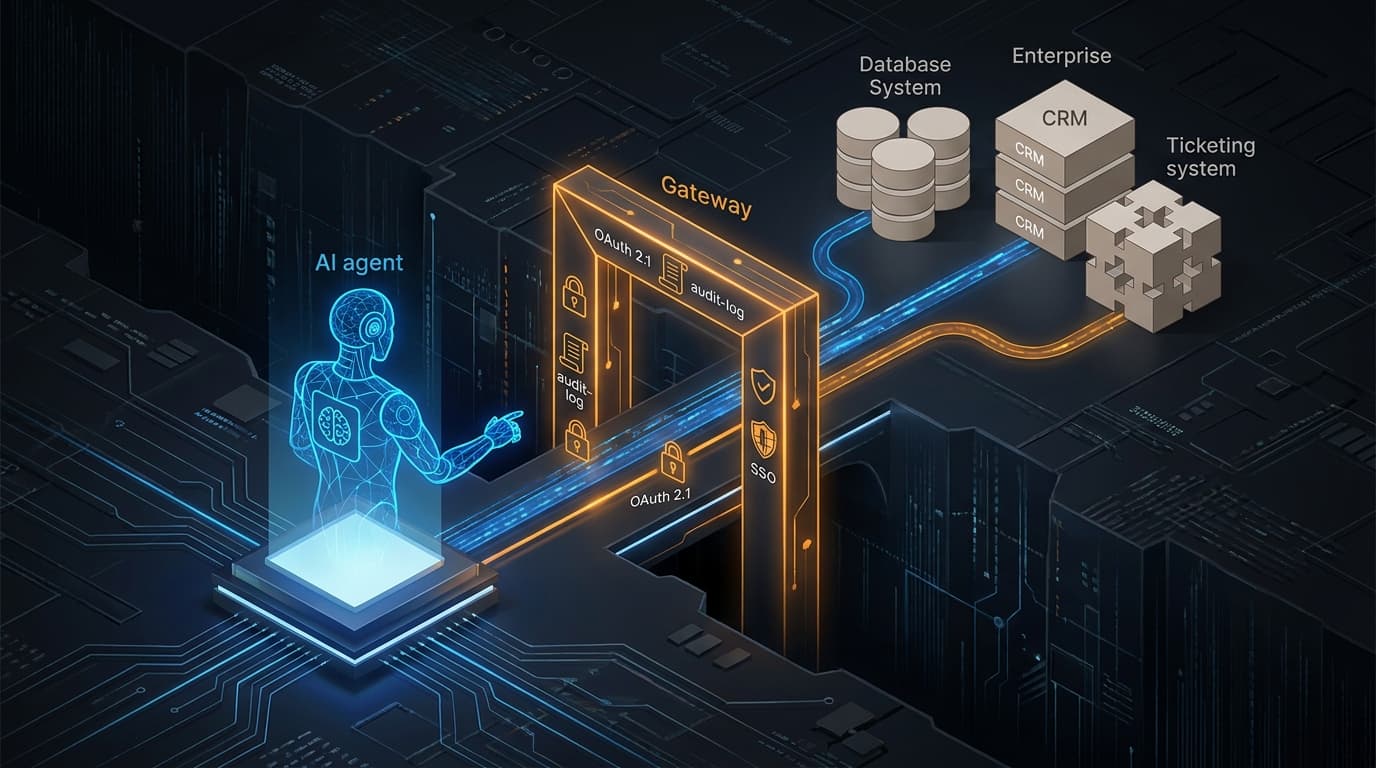
The Model Context Protocol — MCP for short — is no longer a niche experiment. As of April 2026, public reporting puts 78% of enterprise AI teams with at least one MCP-backed agent in production, with 67% of CTOs surveyed naming MCP their default agent-integration standard within twelve months. The official roadmap reports roughly 97 million monthly SDK downloads and over 5,800 MCP servers. For integration leads in DACH enterprises the question stops being "what is this." It starts being "where will it bite us, and what should we do this quarter."
What MCP actually is, briefly
MCP is the wire protocol an AI agent speaks to call external capabilities. Instead of every agent vendor inventing its own tool-calling interface, MCP standardises:
- How an agent discovers what tools a server exposes.
- How it invokes a tool, with what parameters, expecting what response.
- How resources, prompts and progress updates flow back.
- How sessions are scoped, authenticated and terminated.
The right analogy is USB-C for AI integration. The protocol does not specify what tool you build; it specifies how every agent learns to talk to it. Once an enterprise system is fronted by an MCP server, every MCP-aware agent can use it without per-agent integration work.
Why adoption accelerated
Three converging forces explain the move from curiosity to default:
- Every major agent vendor adopted it. Claude Code, OpenCode and most other 2026 agents speak MCP. The decision to expose your enterprise system via MCP no longer locks you into one client.
- The roadmap addressed enterprise gaps. OAuth 2.1 integration, audit-log conventions, gateway patterns and SSO-friendly designs all landed or are landing in the 2026 roadmap.
- The 5,800-server ecosystem. A protocol with a thin community is fragile. A protocol with thousands of servers covers most things you would otherwise build yourself.
Where adoption hurts
The same community reporting that documents the adoption is honest about the friction points enterprises are hitting. The recurring ones, worth knowing before you commit:
Stateful session handling. MCP's session model does not always play nicely with load balancers expecting stateless requests. The 2026 roadmap's Transport Evolution work targets exactly this; in the meantime, expect to do non-trivial work to scale a stateful MCP server horizontally.
Authentication patterns. Plain bearer tokens were the easy path early on. Enterprise SSO and OAuth 2.1 integration are the path everyone is moving to now. If you are starting from scratch, do not skip the OAuth 2.1 step on the assumption it can wait.
Audit and governance. Out-of-the-box logging of tool calls is sparse compared to what compliance teams want. Plan to build (or borrow from the community) the audit-log shipping pattern that turns every MCP invocation into a structured event in your central observability stack.
Long-running task semantics. Asynchronous, retryable tasks — the kind enterprise workflows are full of — are still being refined in the protocol's Tasks primitive. For now, design your tools to be idempotent and short-running where possible.
Gateway patterns. Putting a gateway in front of multiple MCP servers (for centralised auth, rate limiting, policy enforcement) is the obvious pattern; the conventions are still settling. Watch what Stripe, Vercel and similar early adopters publish — they are figuring it out in public.
The realistic path for your enterprise
If you are a DACH enterprise that has not yet committed to an MCP strategy, the four moves that consistently work:
- Pick one internal system where AI agents repeatedly need controlled access to data — your CRM, your ticketing system, your knowledge base. The right candidate has a clean existing API and an owner who is willing.
- Build a single MCP server in front of that system. Expose three to five well-named tools, not the full API surface. Each tool wraps one specific, audited operation.
- Wire OAuth 2.1 from the start. Use your existing SSO. The temptation to ship with a static token is real and is the first thing your security team will reject.
- Ship audit events into your existing observability stack. Caller, tool, parameters, outcome, latency. Same shape you would log any other API call.
That is enough to learn the pattern, see the friction in your own environment, and decide how aggressively to expand.
The MCP question for enterprises in 2026 is not whether to adopt it. It is how narrowly to scope each server, and how seriously to take audit from day one.
Build vs use existing servers
For some systems — Postgres, GitHub, Jira, Slack, Linear — high-quality community MCP servers already exist. Use them where the trust profile fits. For internal or sensitive systems, build your own (we walk through a concrete example in building an MCP server for Oracle Database). The conventions for either choice are well-documented; the question is which path your security team finds easier to sign.
A practical rule: use community servers in non-sensitive contexts, and treat any production server touching regulated data as a server you own and operate, regardless of whether the protocol implementation came from upstream.
What to watch in the next two quarters
Three things on the MCP roadmap that change the calculus:
- Transport Evolution. The stateful-session friction described above is the next major target. Decisions here change how you architect for scale.
- Task refinement. Cleaner async semantics will make MCP a credible substrate for the kind of long-running workflows that currently need bespoke orchestration.
- Governance maturity. The contributor ladder and delegation model emerging at the steering-committee level will change how confident enterprises can be in the protocol's stability.
None of these justify waiting. All of them justify building your first server in a way that can absorb the protocol's evolution — small surface, narrow tools, real auth, real logging.
The enterprise integration shift
MCP is the most consequential integration story of 2026 because it is the moment when "AI agent talking to my systems" becomes a normal integration concern instead of a bespoke project. Forrester's expectation that 30% of enterprise app vendors will launch their own MCP servers in 2026 is plausible. By the time that lands, the question your CIO will be asked is not "do we have MCP." It will be "what does our MCP estate look like." Building one server now, with good defaults, puts you in a position to answer that calmly.