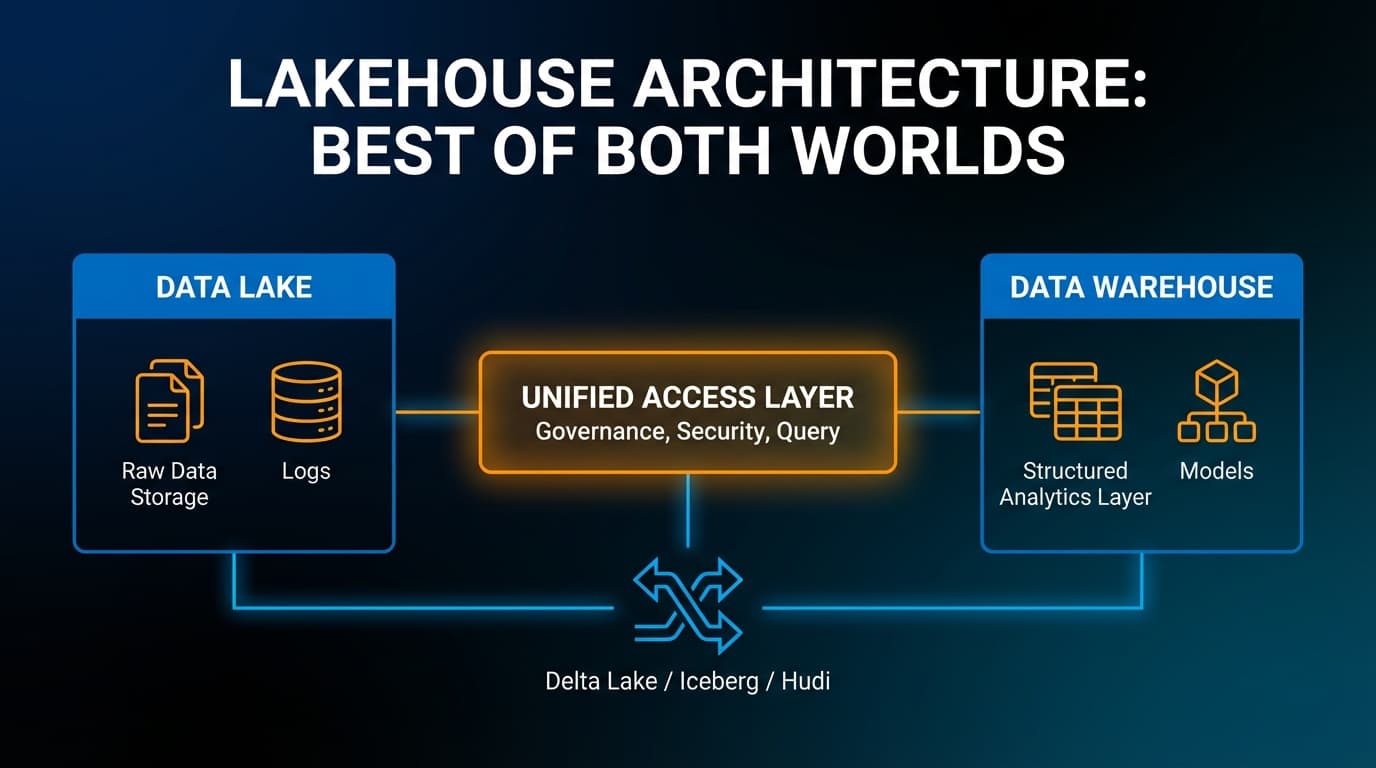
For years, enterprises faced a false choice: the structure and reliability of data warehouses, or the flexibility and scale of data lakes. Data warehouses excelled at BI but struggled with unstructured data and data science workloads. Data lakes handled everything but often became ungoverned swamps. The lakehouse architecture aims to combine the best of both.
What Is a Lakehouse?
A lakehouse is an architecture pattern that adds warehouse-like capabilities to data lake storage. The core idea: store data in open formats on cheap object storage, but add a metadata layer that provides ACID transactions, schema enforcement, and performance optimizations.
Key Technologies
- Delta Lake: Databricks' open-source project, native to Spark
- Apache Iceberg: Netflix-originated, growing adoption across engines
- Apache Hudi: Originally from Uber, strong for streaming ingestion
All three share similar goals but differ in implementation details, engine compatibility, and ecosystem maturity.
A lakehouse is not a product—it's an architecture pattern. The implementation depends on your existing stack and requirements.
What the Lakehouse Enables
ACID Transactions on Object Storage
Traditional data lakes had no transaction support. Concurrent writes could corrupt data. Failed jobs left partial data. Readers could see incomplete updates. Lakehouse formats add transaction logs that provide:
- Atomicity: Writes succeed completely or not at all
- Consistency: Data always reflects a valid state
- Isolation: Concurrent operations don't interfere
- Durability: Committed changes persist
Schema Evolution
Real-world data schemas change. Traditional lakes required reprocessing everything when schemas changed. Lakehouse formats support:
- Adding new columns without rewriting data
- Changing column types with compatibility checks
- Renaming columns while maintaining history
Time Travel
Query data as it existed at any point in history. This enables:
- Auditing and compliance (what did the data look like when that report was generated?)
- Reproducibility (rerun ML training on exact historical data)
- Rollback (undo accidental changes)
Performance Optimizations
- Data skipping: Metadata tracks min/max values per file; queries skip irrelevant files
- Z-ordering: Optimize data layout for common query patterns
- Compaction: Merge small files for better read performance
- Caching: Cache frequently accessed data
When Lakehouse Makes Sense
Strong Fit
- Unified analytics and ML: You need both SQL analytics and data science on the same data
- Diverse data types: Structured, semi-structured, and unstructured data coexist
- Open format preference: You want to avoid vendor lock-in
- Stream and batch convergence: You're combining streaming ingestion with batch processing
- Large data volumes: Warehouse costs become prohibitive at scale
Weak Fit
- Pure BI workloads: If all you need is dashboards and reports, a cloud warehouse is simpler
- Small data volumes: The overhead isn't worth it for smaller datasets
- Limited engineering capacity: Lakehouse requires more engineering expertise than managed warehouses
Lakehouse vs Cloud Data Warehouse
This isn't an either/or choice for many organizations:
| Aspect | Lakehouse | Cloud DW (Snowflake, etc.) |
|---|---|---|
| Storage cost | Lower (object storage) | Higher (proprietary format) |
| Compute flexibility | Multiple engines | Single engine |
| Operational simplicity | More complex | Simpler |
| ML integration | Native | Limited |
| Unstructured data | Natural fit | Limited |
| BI tool ecosystem | Growing | Mature |
Implementation Patterns
Medallion Architecture
The most common lakehouse pattern uses three layers:
- Bronze: Raw data as ingested, minimal transformation
- Silver: Cleaned, validated, deduplicated data
- Gold: Business-level aggregations and curated datasets
This progressive refinement balances data quality with flexibility. Bronze preserves raw data for reprocessing. Gold provides reliable, governed data for consumption.
Hybrid with Data Warehouse
Many enterprises use lakehouse for data engineering and exploration, then sync curated gold-layer data to a cloud warehouse for BI consumption. This provides:
- Lakehouse flexibility for engineering and data science
- Warehouse simplicity and BI tool integration for business users
- Clear separation of concerns
Getting Started with Lakehouse
1. Choose Your Format
Consider your existing stack:
- Using Databricks? Delta Lake is the natural choice
- Multi-engine environment? Apache Iceberg has broader compatibility
- Heavy streaming? Apache Hudi has strong streaming support
2. Start Small
Don't migrate your entire data estate at once. Pick a specific use case:
- A new ML project that needs flexible data access
- A streaming ingestion pipeline
- A data science exploration environment
3. Invest in Governance
Lakehouse doesn't automatically provide governance. You still need:
- Data catalog for discoverability
- Access control (Unity Catalog, Apache Ranger, etc.)
- Data quality monitoring
- Lineage tracking
The Future of Lakehouse
The lakehouse pattern is maturing rapidly. We're seeing:
- Convergence between formats (Iceberg and Delta becoming more compatible)
- Better query engine support across all formats
- Improved BI tool integration
- Enhanced governance capabilities
For enterprises with complex data needs—multiple workloads, diverse data types, cost sensitivity at scale—lakehouse is becoming the architecture of choice.
Considering lakehouse architecture for your organization? Our team helps DACH enterprises evaluate lakehouse options, design target architectures, and implement patterns that balance flexibility with governance.