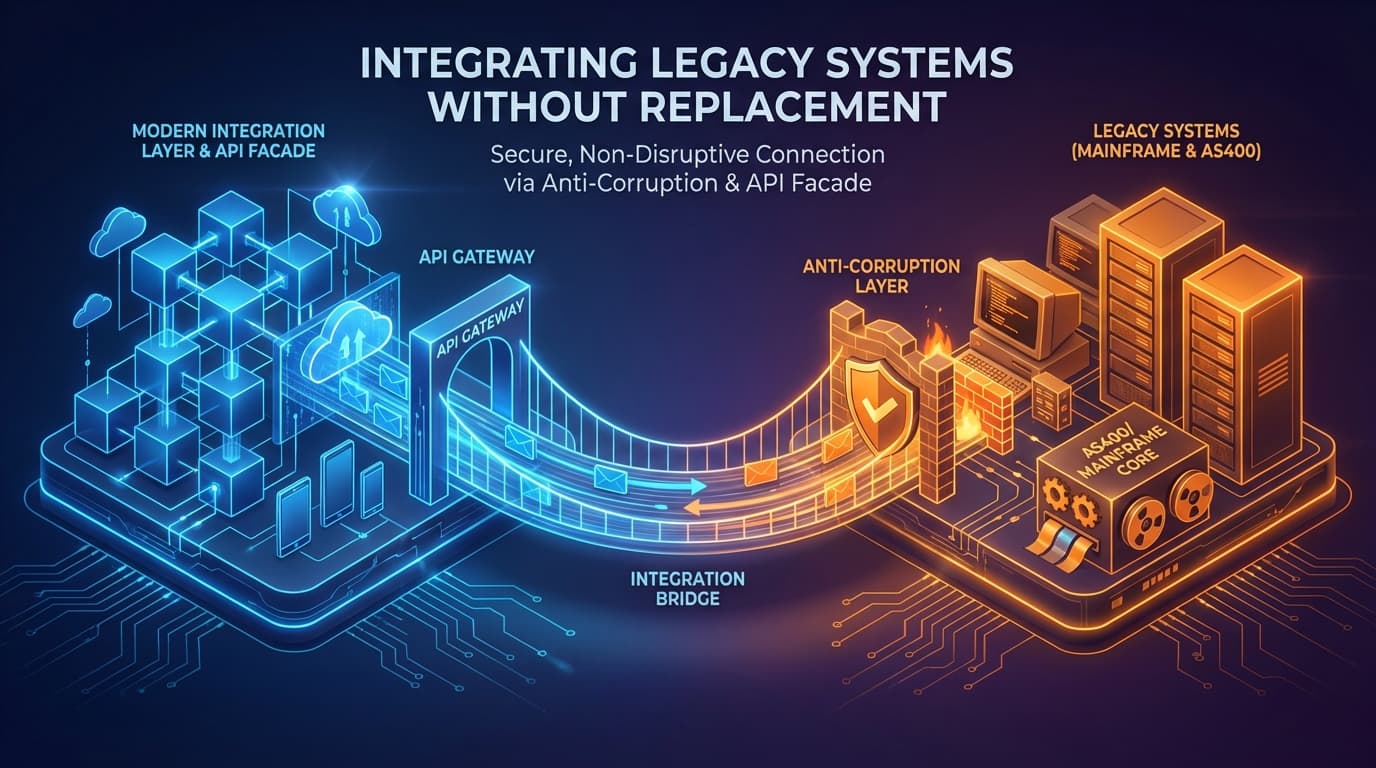
Not every legacy system can—or should—be replaced. That ERP running on an AS/400? It still processes millions of transactions reliably. The problem isn't the legacy system itself; it's making it work with modern applications that speak REST, expect JSON, and assume sub-second response times.
Why Replacement Isn't Always the Answer
Before we discuss integration strategies, let's acknowledge why these systems persist:
- Encoded business logic: Decades of rules live in that COBOL code
- Reliability: Many legacy systems have better uptime than their modern counterparts
- Cost: Replacement projects regularly run into the hundreds of millions
- Risk: Critical business functions depend on systems that "just work"
Integration Patterns That Work
The Anti-Corruption Layer
Don't let legacy concepts leak into modern systems. Build a translation layer that converts legacy data models and protocols into modern equivalents. This protects both sides:
- Modern apps speak their native language
- Legacy systems don't need modification
- Changes to either side are isolated
Database Integration
When APIs don't exist, the database becomes the integration point. This requires care:
- Read from replicas to avoid performance impact
- Use Change Data Capture (CDC) for near-real-time updates
- Never write directly to legacy databases—use designated interfaces
File-Based Integration
Yes, it's 2026 and we're still talking about file transfers. For batch processes, files remain reliable:
- Standardize on formats (CSV, fixed-width, or XML depending on system age)
- Implement robust error handling for partial failures
- Add monitoring to catch stuck transfers
Screen Scraping and RPA
When all else fails, automate the human interface. Robotic Process Automation tools can interact with terminal emulators and legacy GUIs. It's fragile but sometimes the only option.
Building the Modern Facade
The goal is exposing legacy functionality through modern interfaces:
API Gateway Pattern
Place an API gateway in front of legacy systems. The gateway handles:
- Protocol translation (SOAP to REST, EBCDIC to UTF-8)
- Authentication (modern OAuth to legacy credentials)
- Rate limiting (protecting legacy systems from overload)
- Response caching (improving perceived performance)
Event Publishing
Legacy systems can become event producers without internal changes. Monitor their outputs—database changes, file drops, log entries—and publish events for modern consumers.
The best legacy integration is invisible to both sides: legacy systems think they're operating normally, and modern apps don't know they're talking to something built in 1985.
Performance Considerations
Legacy systems weren't designed for modern traffic patterns:
- Implement queuing: Buffer requests to prevent overwhelming legacy backends
- Use async patterns: Don't make users wait for legacy system responses
- Cache aggressively: If data doesn't change often, don't fetch it repeatedly
- Set realistic SLAs: Integration can't be faster than the slowest component
Documentation Is Non-Negotiable
Legacy integration knowledge tends to live in people's heads. Document everything:
- Data mappings between systems
- Error conditions and how to handle them
- Performance characteristics and limits
- Contact information for legacy system owners
Legacy systems aren't going away. The organizations that thrive are those that treat legacy integration as a core competency, not a temporary inconvenience.