Hermes Agent — released in February 2026 by Nous Research under the MIT licence — became one of the year's biggest open-source AI stories almost by accident. Three months after release it had crossed 140,000 GitHub stars, and as of last week it is the most-used agent on OpenRouter. For an enterprise audience the interesting question is not the popularity; it is what makes Hermes architecturally different from the agentic coding tools and AI assistants most teams have already deployed. The answer is worth understanding before the conversation reaches your leadership.
What Hermes Agent is
Hermes Agent is described by Nous Research as a self-improving AI agent that grows with you. In practice, it is an installable agent runtime that you give access to your messaging accounts and a model provider. It then operates as a persistent personal assistant — not a session-bound chat, but a long-running entity that accumulates knowledge of who you are, what tools you use, and how you work.
Three architectural choices distinguish it:
- A built-in learning loop. Hermes creates skills from experience, refines them during use, prompts itself to persist knowledge, and searches its own past conversations. The agent improves at the tasks you give it without retraining a model.
- Model-agnosticism. Hermes runs against Nous Portal, OpenRouter's 200+ models, NovitaAI, NVIDIA NIM, or your own endpoint. The orchestration layer is decoupled from the model layer.
- Operational flexibility. It is designed to run on hardware as small as a $5 VPS or as large as a GPU cluster, with near-zero idle cost. The deployment shape fits both hobbyists and enterprises.
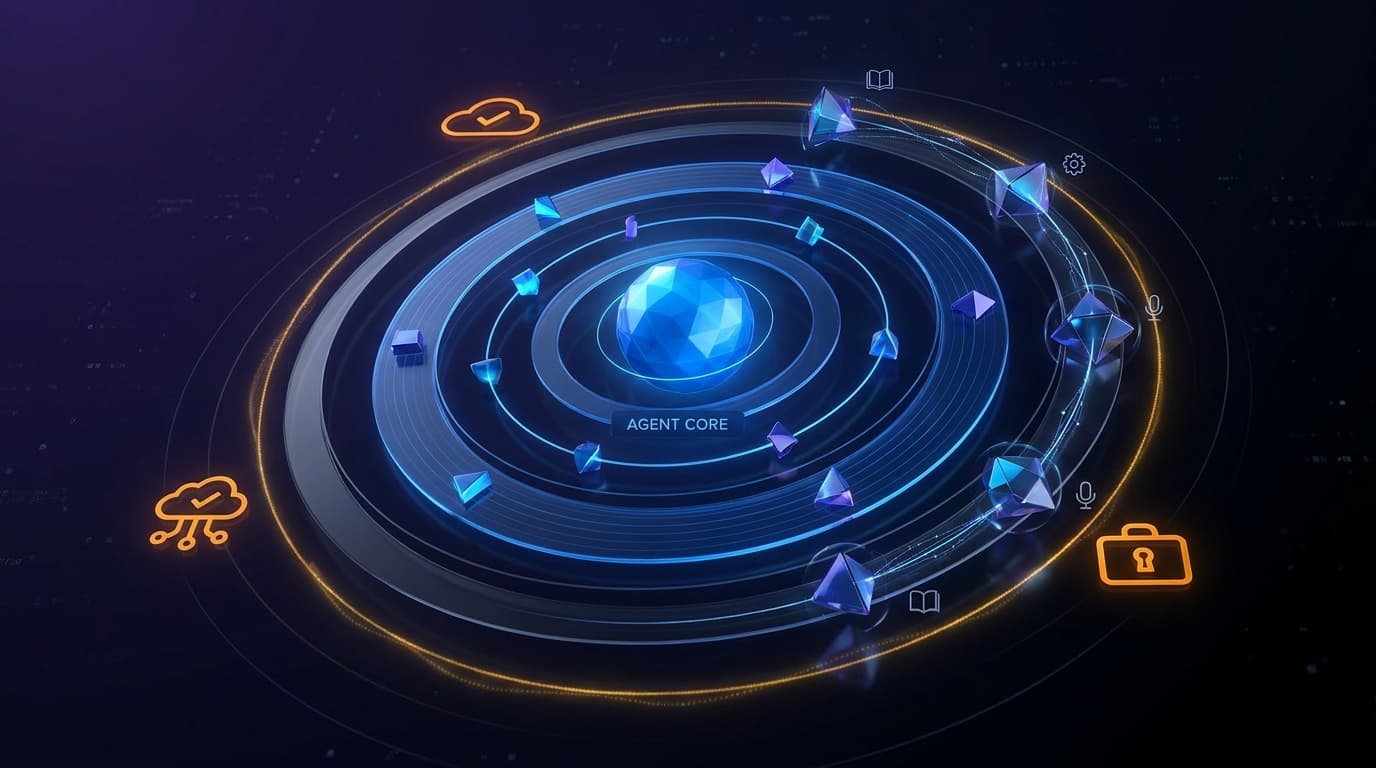
Hermes is also explicitly an orchestration layer, not a thin wrapper around a single chat API. The agent is in charge of the conversation; the model is one component it calls.
Why the self-improvement claim matters
"Self-improving" is a loaded term. Hermes does not modify model weights. What it does is build up a personal corpus of skills and notes — concrete patterns the agent learned work for you — that get retrieved and applied in future sessions. The model behaviour does not change; the agent's working context does, and over time that context becomes increasingly tailored to your actual workflow.
The pragmatic effect is that the agent's hundredth conversation is genuinely better than its first, in a way that is observable and explainable. You can read what the agent learned. You can edit it. You can delete it. The improvement is not magic; it is structured note-keeping with retrieval, run by the agent on itself.
What this means for an enterprise evaluation
Hermes is interesting to enterprises for three reasons that may not be obvious from its consumer framing.
It is a credible reference architecture for personal agents. If your organisation is starting to think about per-employee AI assistants — and many are — Hermes is one of the few open implementations that has been hardened by tens of thousands of users in three months. Even if you do not deploy it directly, reading its design is faster than inventing from scratch.
The model-agnosticism story is real. You can run Hermes against a self-hosted model in your own region for sensitive data, then against a more capable hosted model for less sensitive work, with the same agent and the same accumulated skills. That separation of "agent identity" from "model choice" is the pattern enterprise AI procurement actually wants.
The licence makes governance possible. MIT means you can fork, audit, modify, embed. For an enterprise that needs to certify a tool against internal security standards, that is the licence model that opens the door.
A personal agent that gets better the more you use it is a different product category than a chat assistant. The improvement is the feature, and the architecture for the improvement is what you should evaluate.
What Hermes is not
Honest scoping matters. Hermes is not a Claude Code competitor in the agentic-coding sense — it is a more general personal-agent runtime that can do coding tasks, but is not optimised for production engineering workflows the way the dedicated coding agents are. It is not a replacement for a managed enterprise platform either; running Hermes well still requires you to choose a model strategy, plug in tools and manage the agent's evolving skill store.
It is also worth saying that some of the eye-catching adoption numbers — "most used agent on OpenRouter" — describe individual developer usage, not enterprise deployment. The leading indicator is real and meaningful; the trailing indicator (enterprise rollouts) is still early.
A reasonable first step
If your organisation wants to understand the persistent-agent pattern without committing to a specific tool:
- Install Hermes in a sandbox environment owned by a curious developer, not as an official IT-blessed deployment.
- Connect it to one low-stakes external account (a personal calendar, a single shared document). Observe what it learns.
- Inspect the skills store after a week. Read what got persisted. This is the most concrete material your AI strategy team will have about how persistent agents actually behave.
- Compare to your current AI assistant. Note what Hermes does better, what it does worse, and what categories of question it fails on entirely.
- Decide whether the pattern — not necessarily the product — is worth pursuing for a defined enterprise use case.
The broader signal
Hermes Agent's rapid rise is part of a wider 2026 trend: the agent layer is becoming a real product category, separate from the underlying model layer. We have a model market, and we now have an orchestration market. Enterprises that have spent two years asking "which model" are starting to realise the harder question is "which orchestration layer." Hermes Agent is one credible answer in the open-source column; OpenCode and Claude Code occupy adjacent positions in the coding column. Watching all three lets you understand the shape of the orchestration market without having to pick a winner yet.
The right move is not to deploy Hermes tomorrow. The right move is to read its design with the same seriousness you read your last vendor evaluation. The orchestration layer is where the next wave of enterprise AI decisions will be made, and you want to be informed when those decisions land on your desk.