Every AI vendor has a perfect demo. Flawless accuracy. Instant results. Seamless integration. Then you sign the contract, and reality hits. We've helped DACH enterprises navigate AI procurement for years, and we've seen the same mistakes repeated: buying the demo, not the product.
The best AI demo you'll ever see is the one the vendor controls. The real question is: what happens with your data, your edge cases, your infrastructure?
Here's the evaluation framework we use to separate genuine AI capability from marketing theater.
Phase 1: Requirements Before Demos
Before you see a single demo, define what success looks like. Vendors will shape their pitch to your gaps—so know your gaps first.
Define these before vendor conversations:
- Business outcome: What specific problem are you solving? "Implement AI" is not a requirement
- Success metrics: How will you measure value? Be specific and quantifiable
- Data reality: What data do you actually have, in what format, with what quality?
- Integration requirements: What systems must the solution connect to?
- Scale expectations: What volume, latency, and availability do you need?
- Compliance needs: What regulatory requirements apply?
Phase 2: Beyond the Demo
Demos are theater. Proof of concepts are reality. Insist on testing with your data, in your environment.
Critical questions for every demo:
- "Can we run this on our own data?" (If no, why not?)
- "What's the accuracy on data you haven't seen before?"
- "Show me how it handles edge cases and errors"
- "What does the output look like when confidence is low?"
- "How long did it take to train on this dataset?"
Proof of concept requirements:
- Your data: Not cleaned or curated demo data
- Your edge cases: The difficult examples, not just the easy ones
- Your scale: Test at realistic volumes
- Your evaluation: Measure outcomes, not vendor-provided metrics
Phase 3: Technical Due Diligence
Bring your technical team into evaluation early. Marketing slides don't deploy to production.
Architecture questions:
- Where does inference run? (Cloud, on-premises, edge)
- What's the latency profile under load?
- How does the system scale horizontally?
- What happens when the AI service is unavailable?
- What's the model update and versioning process?
Data handling questions:
- Where is data processed and stored?
- Is data used for model training or improvement?
- What data residency options exist for DACH?
- How is data encrypted at rest and in transit?
- What's the data retention and deletion policy?
Security questions:
- What security certifications do you hold? (ISO 27001, SOC 2)
- How do you handle prompt injection and other LLM attacks?
- What's your vulnerability disclosure and patching process?
- Can we conduct security testing during the POC?
- What happens if there's a data breach?
Phase 4: Vendor Viability
AI is a long-term investment. Your vendor needs to be around to support it.
Business viability questions:
- What's your funding runway or profitability status?
- Who are your other enterprise customers in DACH?
- What's your customer retention rate?
- What happens to our data and models if you're acquired?
- Do you have source code escrow arrangements?
Support and partnership:
- What support is included vs. additional cost?
- Do you have German-speaking technical support?
- What's the escalation path for critical issues?
- What training and enablement do you provide?
- How do you handle feature requests and roadmap input?
Phase 5: Commercial Terms
AI pricing models are often opaque. Understand the true cost before you sign.
Pricing clarity:
- What exactly drives cost? (API calls, tokens, users, data volume)
- What are the costs at 10x your current volume?
- Are there minimum commitments or use-or-lose terms?
- What's included in the base price vs. additional modules?
- How do prices change at contract renewal?
Contract terms to negotiate:
- Data ownership: You retain full ownership of your data
- Training opt-out: Your data isn't used to train vendor models
- SLA guarantees: Uptime, latency, and accuracy commitments
- Exit provisions: Data export and transition support
- Audit rights: Ability to verify security and compliance claims
Red Flags to Watch For
These warning signs should trigger deeper scrutiny:
- "Our AI is proprietary and unique": Often means they can't explain how it works
- Resistance to POC with your data: The demo might not reflect real performance
- "Accuracy rates of 99%+": Ask: on what data, measured how?
- No reference customers in your industry: You're the experiment
- Aggressive discounting for quick signature: Desperation or expiring funding
- Vague answers on data handling: Privacy problems waiting to happen
- "We'll customize that for you": Scope creep and dependency risk
The Reference Check
Always speak with customers the vendor doesn't suggest. Find them through your network.
Questions for references:
- What was the gap between demo and production reality?
- How long did implementation actually take?
- What ongoing effort is required to maintain accuracy?
- How responsive is support when things break?
- Would you choose this vendor again?
Making the Decision
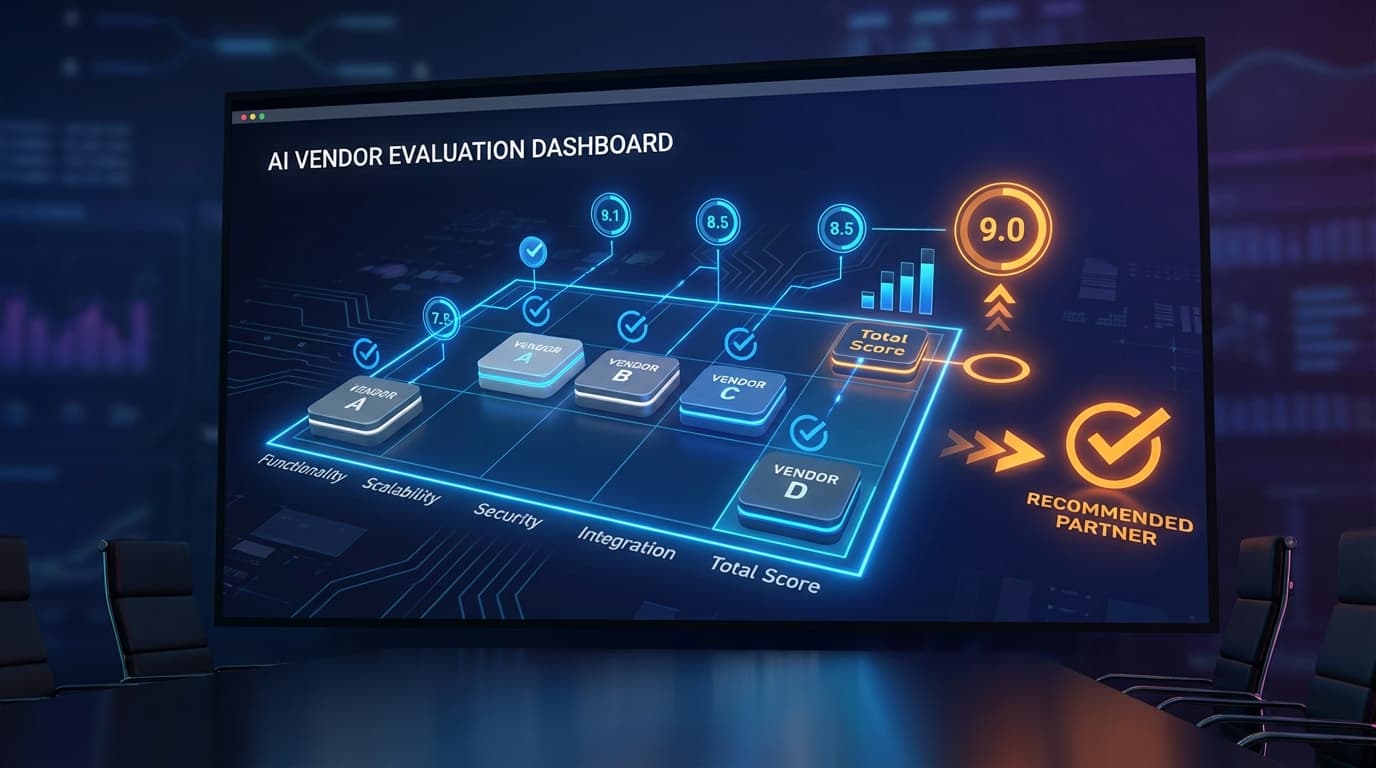
After thorough evaluation, score vendors across these dimensions:
- Technical fit: Does the solution actually solve your problem?
- Proven performance: Demonstrated results with your data
- Integration feasibility: Realistic path to production
- Vendor viability: Will they be here in 3 years?
- Total cost: Including implementation, maintenance, and scaling
- Risk profile: What could go wrong, and how bad would it be?
The best AI vendor isn't the one with the most impressive demo—it's the one whose solution works with your data, integrates with your systems, and delivers measurable value. Take the time to verify before you buy.