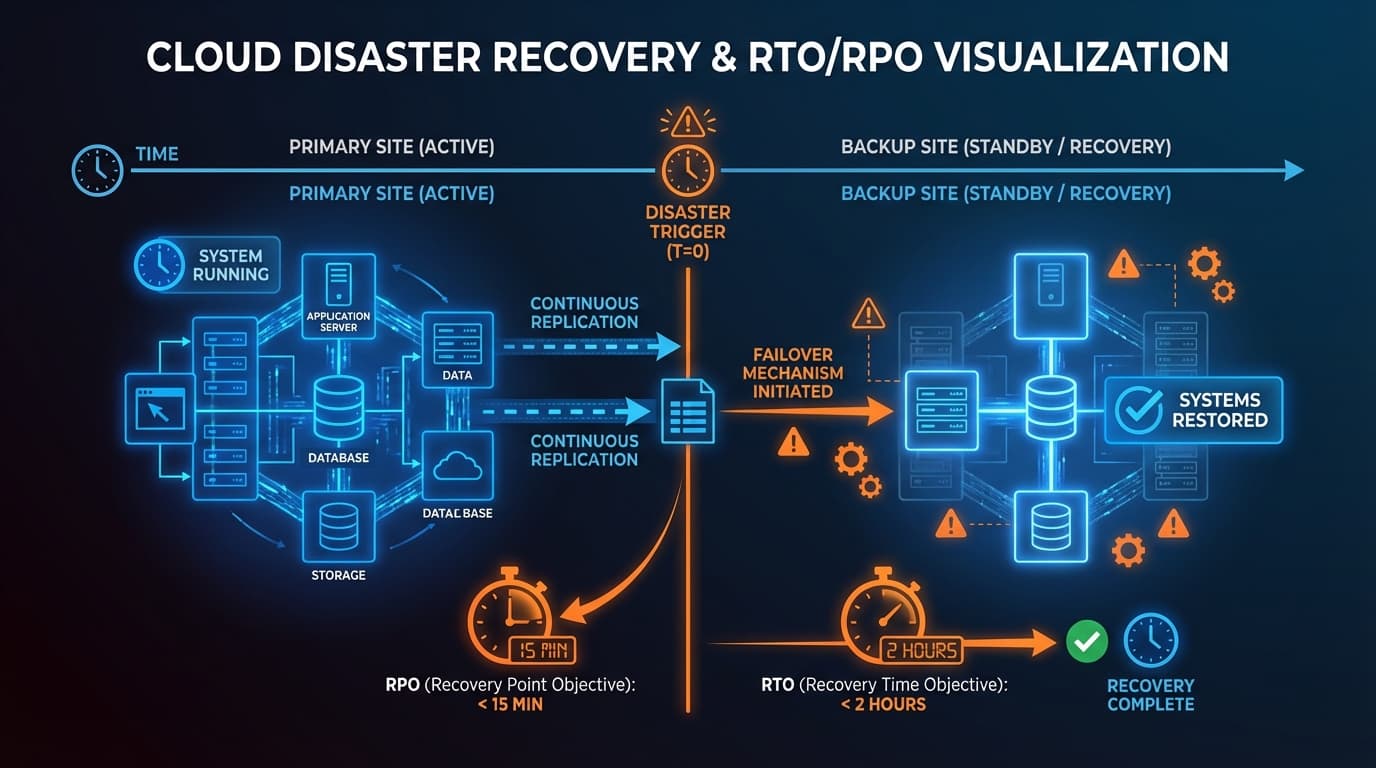
Every organization has a disaster recovery plan. Few have tested it. Fewer still have achieved their stated RTO and RPO targets in actual tests. The gap between DR aspirations and DR reality is where enterprises get hurt. Here's how to close that gap for cloud workloads.
Understanding RTO and RPO (Without the Jargon)
Before diving into architecture, let's clarify what we're actually optimizing:
- RPO (Recovery Point Objective): How much data can you afford to lose? An RPO of 1 hour means you accept losing up to 1 hour of data in a disaster.
- RTO (Recovery Time Objective): How long can you be down? An RTO of 4 hours means the business accepts up to 4 hours of outage.
These numbers should come from business requirements, not IT preferences. A 15-minute RPO costs significantly more than a 4-hour RPO. Make sure the business understands the trade-offs.
The most expensive DR architecture is one built to targets the business doesn't actually need.
Why Cloud DR Is Different
Cloud changes the DR equation in ways that both help and hurt:
The Good
- Multi-region by design: Cloud providers offer geographically distributed regions
- Infrastructure as Code: Rebuild environments in minutes, not weeks
- Managed services: Database replication, storage sync, and failover built in
- Pay-per-use: Standby infrastructure costs less than owned hardware
The Challenges
- Complexity multiplication: More services means more failure points to recover
- Data gravity: Large datasets take time to replicate across regions
- Service dependencies: Your DR might work, but what about your SaaS providers?
- Cost surprises: Cross-region data transfer and standby compute add up
Tiered Recovery: Not Everything Is Critical
The mistake most enterprises make is applying uniform RTO/RPO targets across all workloads. This is both expensive and unnecessary. Tier your applications:
Tier 1: Mission Critical
Revenue-generating systems, customer-facing applications, core business processes. These need the most aggressive targets.
- Typical RTO: 15 minutes to 1 hour
- Typical RPO: Near-zero to 15 minutes
- Architecture: Active-active or hot standby, synchronous replication
Tier 2: Business Important
Internal operations, reporting systems, non-customer-facing services. Important but can tolerate some downtime.
- Typical RTO: 1-4 hours
- Typical RPO: 1 hour
- Architecture: Warm standby, asynchronous replication
Tier 3: Business Supporting
Development environments, archives, secondary systems. Nice to have but not urgent.
- Typical RTO: 24-72 hours
- Typical RPO: 24 hours
- Architecture: Backup and restore, no active standby
Cloud DR Architecture Patterns
Pattern 1: Pilot Light
Core infrastructure runs in the DR region but at minimal capacity. Data replicates continuously. In a disaster, scale up the pilot light to full capacity.
- RTO: 1-4 hours (time to scale)
- RPO: Minutes (depends on replication lag)
- Cost: Low ongoing, high during failover
- Best for: Tier 2 workloads with moderate RTO tolerance
Pattern 2: Warm Standby
A scaled-down but fully functional copy runs in the DR region. Failover means scaling up and redirecting traffic.
- RTO: 15 minutes to 1 hour
- RPO: Minutes
- Cost: Moderate ongoing
- Best for: Tier 1-2 workloads needing faster recovery
Pattern 3: Active-Active
Full capacity runs in multiple regions simultaneously. Traffic is distributed. Failure in one region means traffic shifts to others.
- RTO: Seconds to minutes
- RPO: Near-zero with synchronous replication
- Cost: High (essentially double infrastructure)
- Best for: Tier 1 workloads where any downtime is unacceptable
The Testing Problem
DR plans that aren't tested are DR fantasies. But testing cloud DR is genuinely difficult:
Common Testing Failures
- Partial tests: Testing database failover but not application recovery
- Announced tests: Teams prepare differently when they know it's coming
- Scope limitations: Not testing third-party dependencies or SaaS failover
- Success criteria gaps: "It came up" isn't the same as "customers can transact"
Effective Testing Approach
- Define success criteria: What business functions must work post-recovery?
- Test individual components: Database failover, compute recovery, networking
- Test end-to-end: Full application recovery including dependencies
- Test with real traffic: Canary deployments or traffic shifting during tests
- Surprise tests: Chaos engineering principles—unannounced failures
- Measure and improve: Track actual RTO/RPO achieved, close gaps
Cost Optimization for DR
DR infrastructure often sits idle. Optimize costs without compromising recovery:
- Spot instances: Use spot/preemptible instances for DR compute (with fallback)
- Reserved capacity: Reserve minimum viable DR capacity at discounted rates
- Storage tiering: Use cheaper storage tiers for less critical backup data
- Replication optimization: Replicate intelligently—not everything needs real-time sync
- Test environment reuse: DR environments can double as performance testing during normal operations
Documentation and Runbooks
When disaster strikes, adrenaline impairs judgment. Your DR documentation should assume the operator is stressed and tired:
- Step-by-step runbooks: No assumptions, no abbreviations
- Decision trees: Clear criteria for when to fail over (and when not to)
- Contact lists: Who to call, in what order, with direct numbers
- Verification steps: How to confirm recovery succeeded
- Rollback procedures: How to return to primary when it's safe
Making DR Real
The organizations with effective DR share common traits: they treat DR as an ongoing practice, not a one-time project. They test regularly. They budget appropriately. They accept that DR capability has a cost.
Need help designing cloud DR architecture that meets your business requirements? Our team has designed and tested disaster recovery solutions for DACH enterprises across industries. We can help you build DR capability that works when you need it—not just on paper.