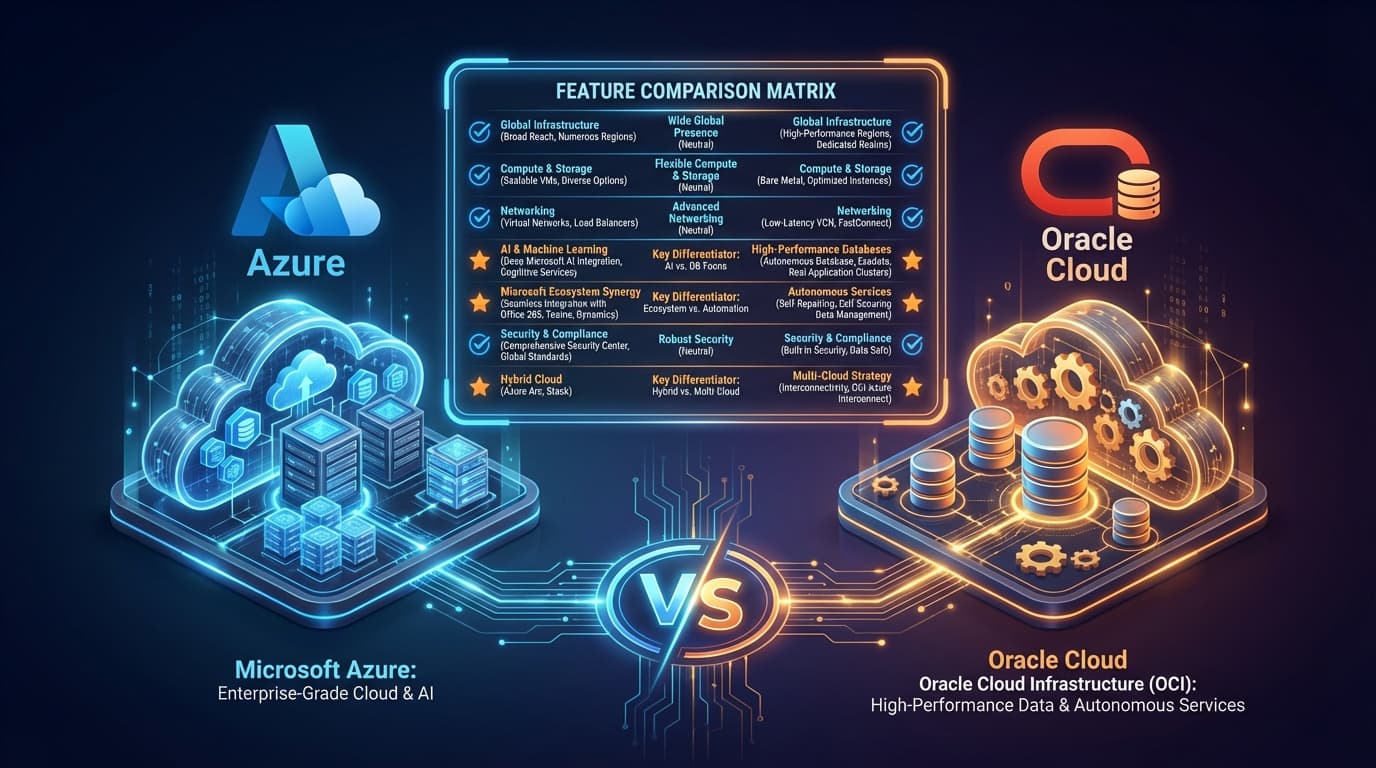
When enterprise architects in the DACH region evaluate cloud platforms, the conversation usually starts with AWS and Azure. But Oracle Cloud Infrastructure (OCI) has quietly become a serious contender—especially for organizations already invested in Oracle technologies. Here's what nobody tells you about choosing between Azure and Oracle Cloud for enterprise workloads.
Why This Comparison Matters Now
Oracle has transformed OCI from a niche offering into a genuinely competitive platform. Meanwhile, Azure continues to dominate the European enterprise market with deep Microsoft integration. For CTOs evaluating options, the decision isn't straightforward—and getting it wrong is expensive.
We've helped DACH enterprises migrate workloads to both platforms. This comparison reflects real project experience, not vendor marketing.
The best cloud platform isn't the one with the most features—it's the one that aligns with your existing investments and future direction.
Where Oracle Cloud Wins
Oracle Database Workloads
This is obvious but worth emphasizing: if your enterprise runs on Oracle Database, OCI offers advantages Azure cannot match. Native Oracle RAC support, Exadata Cloud Service, and Autonomous Database provide performance and features unavailable elsewhere.
One financial services client reduced their Oracle licensing costs by 40% by moving from on-premises to OCI—Oracle's licensing terms are significantly more favorable on their own cloud.
Predictable Pricing
Oracle's pricing model is refreshingly straightforward. Egress costs are dramatically lower than Azure (and AWS). For data-intensive workloads, this difference alone can shift the TCO calculation significantly.
- Outbound data: OCI offers 10TB free monthly egress vs. Azure's metered pricing
- OCPU pricing: More predictable than Azure's complex VM pricing tiers
- Support: Premier support included in many OCI services
High-Performance Computing
OCI's bare metal instances and low-latency networking make it compelling for HPC workloads. RDMA cluster networking delivers performance that matches on-premises environments—something Azure achieves only with specific (expensive) instance types.
Where Azure Wins
Microsoft Ecosystem Integration
For enterprises running Microsoft 365, Dynamics 365, or Power Platform, Azure integration is seamless. Single sign-on, unified management, and native connectivity create operational efficiencies OCI cannot replicate.
A manufacturing client using Dynamics 365 found that Azure integration reduced their IT management overhead by 25%—the Microsoft ecosystem advantage is real.
Developer Experience and Services
Azure's breadth of PaaS services exceeds Oracle's offerings. Azure Functions, Logic Apps, Cognitive Services, and the broader Azure ecosystem provide capabilities that accelerate development:
- AI/ML services: Azure OpenAI Service, Cognitive Services, ML Studio
- Integration: Logic Apps, API Management, Event Grid
- DevOps: Azure DevOps, GitHub Actions integration
European Data Residency
Azure's German and Swiss regions offer comprehensive data residency options. OCI has Frankfurt and Zurich regions, but Azure's European footprint is larger with more services available in each region.
The Hidden Trade-offs Nobody Mentions
Talent Availability
Finding Azure-skilled engineers in the DACH region is straightforward. OCI expertise is scarcer. This affects hiring, training costs, and your ability to maintain systems long-term. Don't underestimate this factor.
Vendor Lock-in Reality
Both platforms create lock-in, but differently. Azure locks you into the Microsoft ecosystem through integration benefits. Oracle locks you through database licensing economics. Understand which lock-in you're accepting.
Support Quality Variance
Enterprise support quality varies significantly. Azure support through Microsoft Enterprise Agreements is well-established. Oracle's cloud support is improving but historically inconsistent. Request support SLAs in writing.
Decision Framework: Which Platform When?
Based on our project experience, here's a practical decision framework:
- Choose OCI when: Oracle Database is central to your operations, egress costs matter, or you need bare-metal HPC performance
- Choose Azure when: Microsoft ecosystem is your foundation, developer experience is priority, or you need the broadest service selection
- Consider hybrid: OCI for Oracle workloads, Azure for everything else—Oracle Interconnect makes this viable
The Hybrid Option
Oracle and Microsoft partnered to offer direct interconnection between OCI and Azure. This isn't marketing—it's a low-latency, private connection that enables genuine hybrid architectures. For enterprises with significant Oracle database investments wanting Azure's broader services, this hybrid approach often makes the most sense.
Making the Right Choice for Your Enterprise
Cloud platform decisions shouldn't be made on feature comparisons alone. Consider your existing investments, team capabilities, and strategic direction. Both Azure and Oracle Cloud are mature enterprise platforms—the right choice depends entirely on your context.
Need help evaluating cloud platforms for your specific workloads? Our team has hands-on experience with both Azure and OCI migrations in the DACH region. We can help you make the decision based on your reality, not vendor promises.