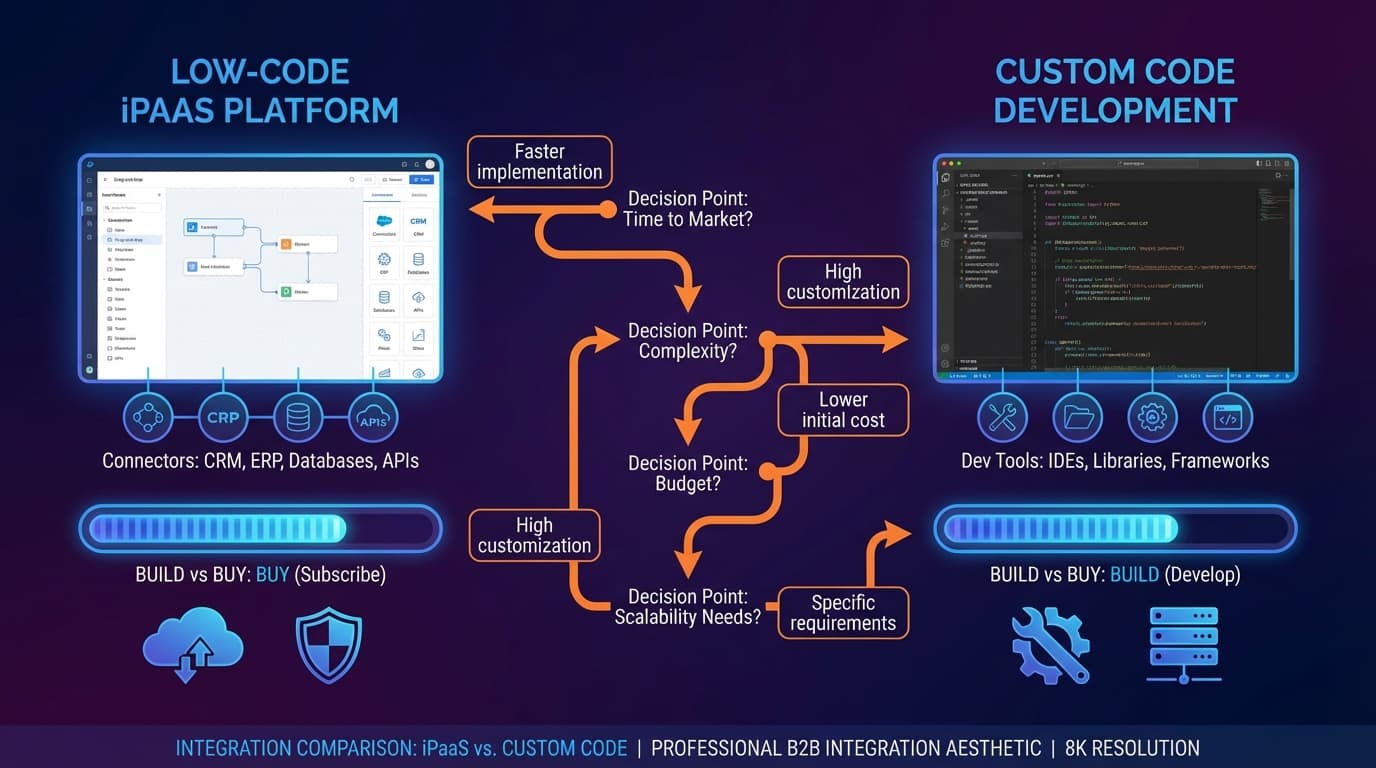
Every enterprise faces the same integration dilemma: should we buy an Integration Platform as a Service (iPaaS) like MuleSoft, Boomi, or Workato, or build custom integrations tailored to our exact needs? The answer isn't as simple as most vendors would have you believe.
The True Cost of Integration
When evaluating integration approaches, most teams focus on the wrong metrics. They compare vendor licensing costs against developer time—a calculation that misses the bigger picture.
The real costs include:
- Ongoing maintenance: Custom code requires continuous updates as APIs change
- Knowledge concentration: Custom solutions often become dependent on specific team members
- Scalability overhead: Building for growth adds complexity and cost
- Security responsibility: You own the entire security surface area
When iPaaS Makes Sense
iPaaS platforms shine in specific scenarios. If your integration needs match these patterns, buying makes more sense:
Standard SaaS-to-SaaS Integration
Connecting Salesforce to HubSpot? Syncing NetSuite with your e-commerce platform? iPaaS vendors have pre-built connectors that handle the heavy lifting. You'd spend months building what they've already perfected.
Non-Technical Team Ownership
When business users need to modify integration logic, iPaaS visual designers become invaluable. The alternative—training non-developers to modify code—rarely works at scale.
Rapid Time-to-Value
Need integrations running in weeks, not months? iPaaS gets you there faster, assuming your use case fits their paradigm.
When Custom Integration Wins
Custom development remains the right choice in several scenarios:
Unique Business Logic
When your competitive advantage depends on integration logic, you don't want to be constrained by what an iPaaS platform can express. Custom code gives you unlimited flexibility.
High-Volume, Low-Latency Requirements
iPaaS platforms add overhead. For real-time integrations processing thousands of transactions per second, custom solutions optimized for your exact workload often perform better.
Legacy System Integration
Connecting to mainframes, proprietary protocols, or systems without modern APIs often requires custom code regardless. iPaaS connectors usually assume HTTP/REST or standard protocols.
The Hybrid Approach
Most mature enterprises adopt a hybrid strategy:
- iPaaS for standard business application integrations
- Custom development for core differentiating capabilities
- API gateway as the common layer for security and monitoring
The best integration architecture isn't about choosing one approach—it's about applying the right approach to each integration challenge.
Decision Framework
Ask these questions for each integration project:
- Does an iPaaS connector already exist for both endpoints?
- Is the integration logic standard or highly customized?
- Who will own and maintain this integration long-term?
- What are the volume and latency requirements?
- How critical is this integration to business operations?
The answers will guide you toward the right approach. Don't let vendor marketing or developer preferences drive what should be a business-aligned technical decision.