Mention "data governance" in a meeting and watch eyes glaze over. The term conjures images of endless committee meetings, 200-page policy documents nobody reads, and approval workflows that take weeks. Yet effective data governance is essential—especially as regulations tighten and data becomes more critical to business operations.
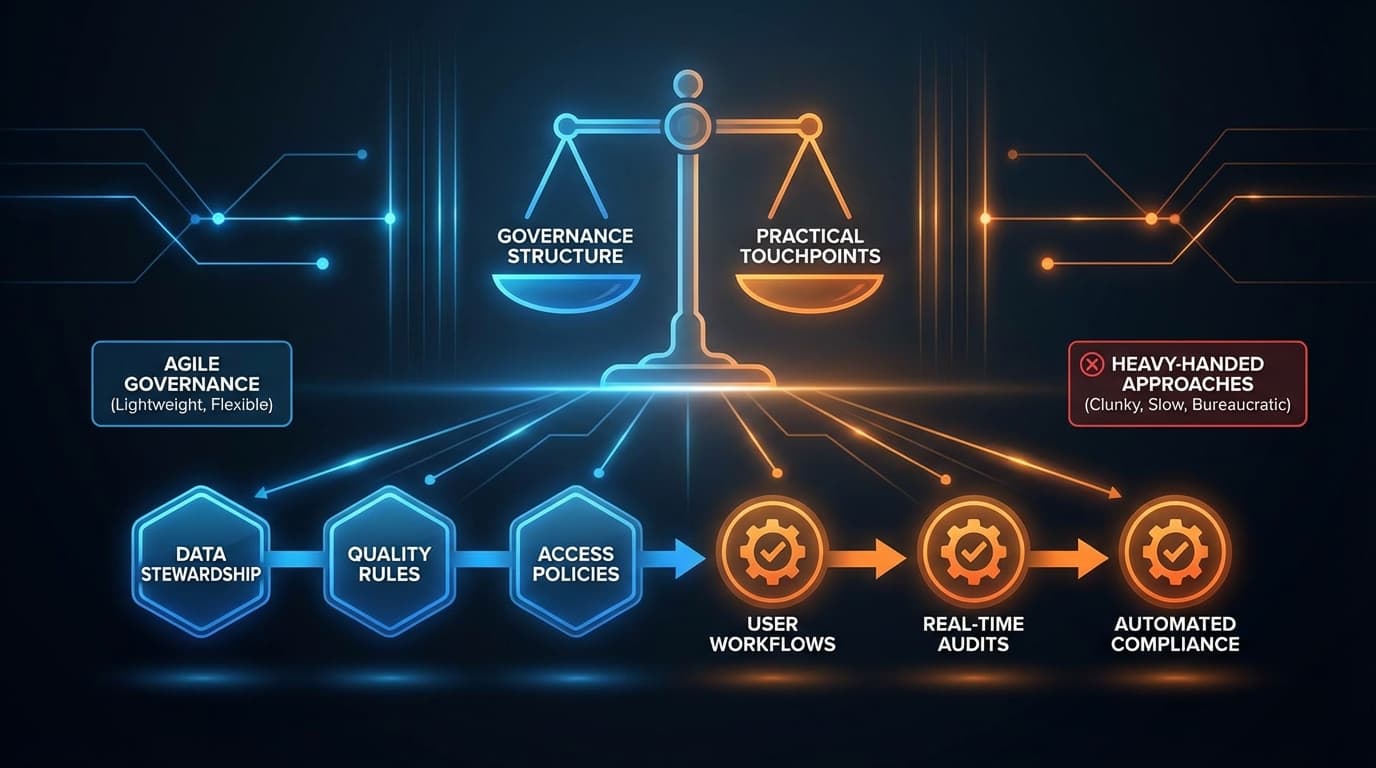
The good news: governance doesn't have to be bureaucratic. The organizations we've seen succeed treat governance as an enabler, not a control mechanism. Here's how to build governance that actually works.
Why Traditional Governance Fails
Traditional data governance initiatives often fail for predictable reasons:
- Policy over practice: Creating comprehensive policies before understanding how data actually flows through the organization
- Governance by committee: Endless steering groups with no decision-making authority
- One-size-fits-all: Applying the same governance rigor to all data regardless of sensitivity or value
- No business alignment: Governance imposed by IT without business ownership
- Manual everything: Relying on human processes that can't scale
The goal of governance is not to control data—it's to enable trusted, compliant use of data at the speed the business requires.
The Pragmatic Governance Framework
Effective governance focuses on three things: data you must govern (compliance), data you should govern (business-critical), and data that governs itself (automated controls).
Tier 1: Must Govern (Regulatory Compliance)
Some data requires formal governance—personal data under GDPR, financial data under regulatory requirements, health data under sector-specific rules. For this data:
- Establish clear data stewards with accountability
- Document data lineage end-to-end
- Implement access controls and audit trails
- Maintain retention and deletion policies
- Regular compliance reviews and attestations
Tier 2: Should Govern (Business-Critical)
Revenue-impacting data, customer-facing analytics, operational metrics. For this data:
- Define data quality standards and monitor them
- Establish single sources of truth for key metrics
- Document business definitions in a data catalog
- Implement change management for critical datasets
Tier 3: Self-Governing (Automated Controls)
Departmental analytics, exploratory data, development datasets. For this data:
- Automated classification based on content
- Default retention policies
- Self-service access with automated approval workflows
- Light-touch monitoring for anomalies
Data Stewardship That Works
Data stewardship fails when it's a part-time afterthought. Success requires:
Business Ownership
Data stewards should come from the business, not IT. They understand how data is used and what quality means in context. IT provides tools and platforms; the business owns the data.
Clear Scope
Each steward owns specific data domains—not everything. A customer data steward isn't responsible for manufacturing data. Keep scope manageable.
Actual Authority
Stewards need authority to make decisions about their data domains—quality standards, access approvals, change management. Advisory roles without authority accomplish nothing.
Time Allocation
Stewardship is not a free add-on to someone's job. Allocate real time—10-20% for significant data domains. Build stewardship into performance expectations.
Data Quality: Measure What Matters
Data quality initiatives often drown in metrics. Focus on dimensions that impact business decisions:
- Accuracy: Does the data reflect reality? For customer data, is the address current?
- Completeness: Are required fields populated? What percentage of records are complete?
- Timeliness: Is data available when decisions need to be made? What's the latency?
- Consistency: Does the same customer appear the same way across systems?
- Validity: Does data conform to business rules? Are values within expected ranges?
For each critical data asset, define acceptable thresholds and automate monitoring. Alert on degradation; don't wait for quarterly reviews.
The Data Catalog: Your Governance Foundation
A data catalog is not optional for governance at scale. It provides:
- Discoverability: Users find data assets without asking around
- Business context: What does this data mean, who owns it, how should it be used?
- Lineage: Where did this data come from, how was it transformed?
- Quality metrics: Current quality scores and trends
- Access policies: Who can access and under what conditions
Start with critical data assets and expand organically. A sparse but accurate catalog beats a comprehensive but stale one.
Automation: The Governance Accelerator
Manual governance doesn't scale. Automate where possible:
- Data classification: Use ML to identify sensitive data automatically
- Quality monitoring: Continuous data quality checks, not periodic audits
- Access management: Self-service requests with automated policy enforcement
- Lineage capture: Automatic lineage tracking in data pipelines
- Policy enforcement: Guardrails in the platform, not in documentation
Getting Started: The 90-Day Plan
Days 1-30: Foundation
- Identify your most critical data assets (start with 5-10)
- Assign business owners for each
- Document current state: Who uses it? What quality issues exist?
Days 31-60: Quick Wins
- Establish quality metrics and monitoring for critical assets
- Create basic catalog entries with business definitions
- Implement access controls for sensitive data
Days 61-90: Operationalize
- Regular steward check-ins (weekly, brief)
- Quality dashboards visible to stakeholders
- Incident response process for data issues
Governance as Enabler
When governance works, users don't notice it—they simply find trusted data, understand what it means, and use it confidently. That's the goal: invisible governance that enables rather than obstructs.
Need help building pragmatic data governance for your organization? Our team helps DACH enterprises implement governance frameworks that balance compliance requirements with business agility. No 200-page policy documents required.