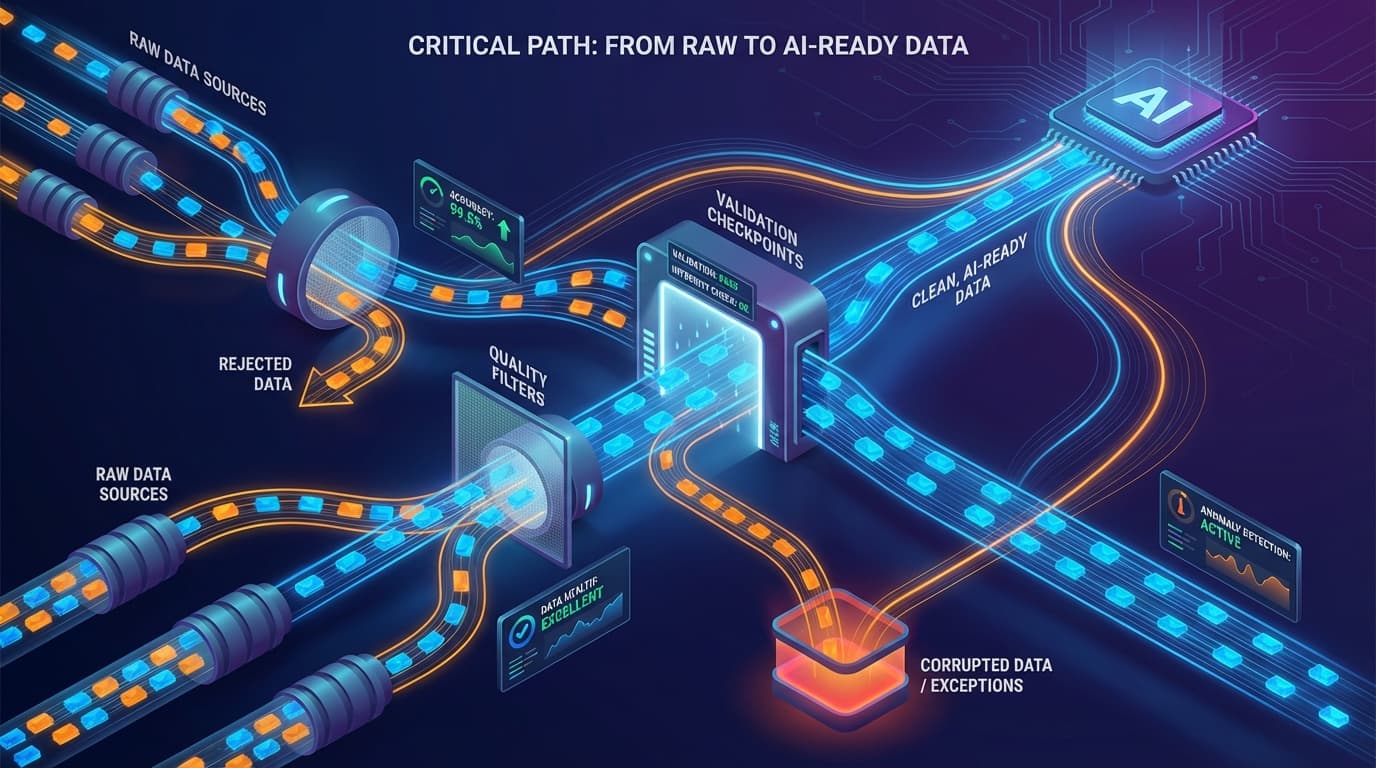
We've assessed dozens of AI initiatives across DACH enterprises. The pattern is consistent: teams obsess over model selection, hyperparameters, and architecture—then wonder why their carefully crafted AI performs terribly. The answer is almost always data. Your model is only as good as what you feed it.
The most sophisticated AI architecture built on poor data will underperform a simple model trained on clean, relevant, well-structured data. Every time.
Here's the data quality checklist we use before recommending any AI investment. Use it to assess your readiness—or identify the gaps you need to close first.
1. Data Availability
Before anything else: do you have the data you need?
Checklist:
- [ ] Is the required data currently being captured?
- [ ] Do you have sufficient historical data for training (typically 6-24 months)?
- [ ] Is the data accessible, or locked in legacy systems?
- [ ] Can you legally use this data for AI purposes (consent, contracts, regulations)?
- [ ] Is the data in a format that can be processed (not just PDFs and images)?
Red flags:
- "We'll start collecting that data when we build the AI"
- "The data is there, somewhere in SAP"
- "Legal hasn't reviewed the data usage yet"
2. Data Completeness
Missing data creates bias and reduces model accuracy. How complete are your datasets?
Checklist:
- [ ] What percentage of records have complete fields?
- [ ] Are missing values random, or do they follow patterns (which could introduce bias)?
- [ ] Do you have edge cases and rare events represented?
- [ ] Is the data representative across all relevant segments (time periods, regions, customer types)?
- [ ] Have you quantified the completeness level for each critical field?
Red flags:
- Critical fields with more than 20% missing values
- Entire time periods or segments with no data
- Optional fields that were rarely filled in
3. Data Accuracy
Garbage in, garbage out. How confident are you that your data reflects reality?
Checklist:
- [ ] Are there validation rules at data entry points?
- [ ] How do you detect and handle data entry errors?
- [ ] Is there a single source of truth, or conflicting data sources?
- [ ] When was the data last validated against real-world outcomes?
- [ ] Are there known data quality issues that haven't been addressed?
Red flags:
- "We know the CRM data has issues, but everyone works around them"
- Multiple systems with the same data that don't match
- No recent audit of data accuracy
4. Data Consistency
Inconsistent data confuses models. Are your naming conventions, formats, and definitions consistent?
Checklist:
- [ ] Are field definitions documented and consistently applied?
- [ ] Are date/time formats standardized across sources?
- [ ] Are categorical values consistent (no "Germany" vs "DE" vs "Deutschland")?
- [ ] Are numerical units consistent (EUR vs cents, kg vs grams)?
- [ ] Has the data schema changed over time, and are old records compatible?
Red flags:
- Free-text fields where structured data should be
- Data merged from acquisitions without standardization
- Schema changes without migration of historical data
5. Data Freshness
Stale data leads to stale predictions. How current is your data?
Checklist:
- [ ] How frequently is data updated?
- [ ] What's the latency between real-world events and data availability?
- [ ] Are there bottlenecks in the data pipeline causing delays?
- [ ] Do you have near-real-time data if your use case requires it?
- [ ] Is historical data still representative of current conditions?
Red flags:
- Monthly batch updates for time-sensitive use cases
- Manual data entry creating days of latency
- "The data warehouse refreshes overnight"
6. Data Labeling
Supervised learning requires labels. How reliable are your labels?
Checklist:
- [ ] Are labels based on objective criteria or subjective judgment?
- [ ] Is there inter-annotator agreement (do different people label the same way)?
- [ ] Are labels current, or do they reflect outdated classifications?
- [ ] Do you have enough labeled examples for each class?
- [ ] Are edge cases and ambiguous examples labeled consistently?
Red flags:
- "We'll have the interns label the training data"
- No quality control on the labeling process
- Labels assigned by systems with known errors
7. Data Bias
Biased data produces biased AI. Have you audited for bias?
Checklist:
- [ ] Does your data reflect the full population you'll serve?
- [ ] Are historically disadvantaged groups adequately represented?
- [ ] Does your data encode historical biases you don't want to perpetuate?
- [ ] Have you tested for disparate impact across protected groups?
- [ ] Is there selection bias in how data was collected?
Red flags:
- Training data only from certain regions or time periods
- Historical decisions (hiring, lending) used as labels
- No demographic analysis of the training data
8. Data Security and Privacy
AI doesn't exempt you from data protection. Is your data properly secured?
Checklist:
- [ ] Is personal data properly anonymized or pseudonymized?
- [ ] Do you have consent for AI usage of the data?
- [ ] Are access controls in place for sensitive data?
- [ ] Is data encrypted at rest and in transit?
- [ ] Have you assessed GDPR/DSGVO compliance for your AI use case?
Red flags:
- "We'll figure out privacy later"
- Training data with personally identifiable information
- No data processing agreement for AI purposes
Data Quality Scoring
Use this simple framework to score your data readiness:
- Green (Ready): You can check all boxes in a category
- Yellow (Addressable): 1-2 gaps that can be fixed with reasonable effort
- Red (Blocker): Fundamental issues that must be resolved before proceeding
A single red in any category should pause your AI project until resolved. Multiple yellows might still proceed, but with extended timelines and risk buffers.
The Data Quality Investment
Here's the uncomfortable truth: fixing data quality isn't sexy, and it doesn't produce demos you can show the board. But enterprises that invest in data quality before AI initiatives consistently outperform those who rush to model building.
The best AI projects we've seen start with a simple question: "Is our data ready?" If the answer is no, the right move isn't to proceed anyway—it's to fix the foundation first. The enterprises winning with AI are the ones who treat data quality as a prerequisite, not an afterthought.