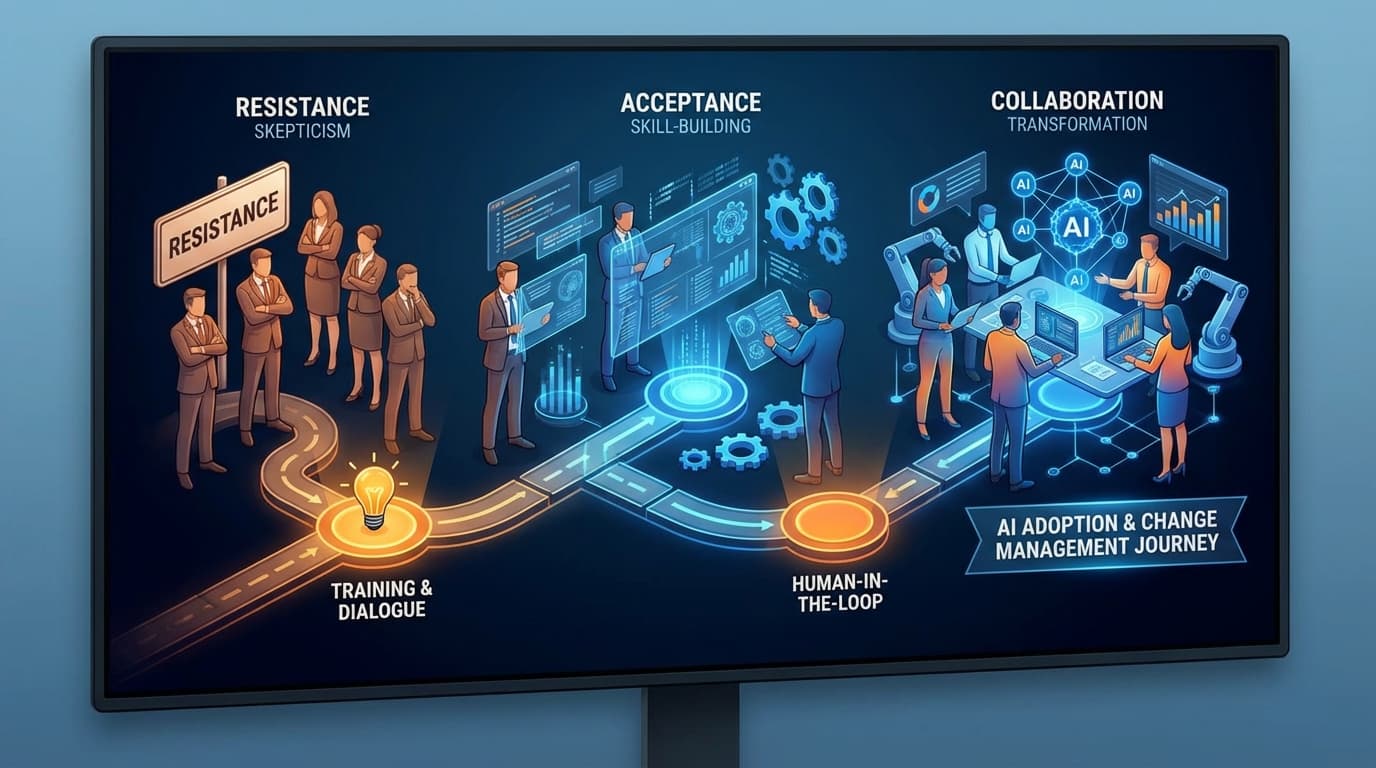
We've seen it countless times: a perfectly implemented AI system that nobody uses. The technology works flawlessly. The business case is solid. But six months after launch, adoption is stuck at 15% and executives are questioning the investment. The problem isn't the AI—it's the change management.
Technology adoption is 20% technology and 80% people. Get the people part wrong, and your AI investment becomes expensive shelfware.
Here's what we've learned about winning over reluctant employees in DACH enterprises.
Understanding the Resistance
Before you can address resistance, you need to understand it. Most AI resistance isn't irrational—it's based on legitimate concerns.
The fears driving resistance:
- Job security: "Will this AI replace me?"
- Skill obsolescence: "Will my expertise become worthless?"
- Performance anxiety: "Will I look incompetent if I can't use this?"
- Loss of autonomy: "Is AI making my decisions now?"
- Quality concerns: "Will AI mistakes make me look bad?"
- Workflow disruption: "I already have a system that works"
The hidden resistance:
Not all resistance is visible. Watch for:
- Minimum compliance—using AI only when required, reverting immediately
- Workarounds—finding ways to avoid the AI system entirely
- Passive-aggressive adoption—using AI poorly to prove it doesn't work
- Data sabotage—feeding bad inputs to generate bad outputs
The Transparency Imperative
In German-speaking countries, works councils and employee representatives have significant power. But beyond legal requirements, transparency is simply good change management.
What to communicate early:
- The why: Why is the company investing in AI? What problem are we solving?
- The impact: Which roles will be affected and how?
- The timeline: When will changes happen?
- The support: What training and resources will be provided?
- The commitment: What is the company's position on AI-related job changes?
What to avoid:
- Surprise rollouts that blindside employees
- Vague reassurances without specifics
- Overselling AI capabilities
- Ignoring works council involvement where required
Framing AI as Augmentation
How you position AI matters enormously. "AI will make you more efficient" sounds like a threat. "AI will handle the boring parts so you can focus on interesting work" sounds like a benefit.
Reframing strategies:
- From replacement to enhancement: "AI handles data entry so you can focus on analysis"
- From monitoring to support: "AI helps catch errors before they reach customers"
- From standardization to quality: "AI ensures consistency while you handle complexity"
- From automation to expertise: "AI learns from your expertise and scales it"
Show, don't tell:
Abstract benefits don't convince skeptics. Demonstrate specific improvements:
- "This report that took 3 hours now takes 20 minutes"
- "You'll never have to manually copy data between systems again"
- "The AI catches the errors that are easy to miss at 5 PM Friday"
The Power of Champions
Top-down mandates create compliance, not enthusiasm. Peer influence creates adoption.
Finding champions:
- Look for respected employees with moderate tech curiosity (not just the tech enthusiasts)
- Include skeptics who can be converted—their endorsement is powerful
- Ensure champions represent different departments and roles
- Choose people with informal influence, not just formal authority
Enabling champions:
- Give them early access and training
- Create feedback channels so they can shape the implementation
- Recognize their contributions publicly
- Give them time to support colleagues (this is real work, not extra work)
Training That Actually Works
A 2-hour workshop followed by "read the documentation" is not training. Effective AI training is ongoing and practical.
Effective training elements:
- Role-specific: Training for how this role will use AI, not generic capabilities
- Hands-on: Practice with real tasks, not demo scenarios
- Incremental: Build complexity over time, don't front-load
- Safe to fail: Sandbox environments for experimentation
- Peer learning: Team-based sessions where colleagues help each other
Ongoing support:
- Office hours with AI experts
- Slack/Teams channels for quick questions
- Regular tip-sharing sessions
- Updated documentation as the system evolves
Managing the Adoption Curve
Expect different adoption speeds. Plan for this, don't fight it.
The typical adoption curve:
- Enthusiasts (10-15%): Will adopt immediately, need minimal support
- Early majority (30-35%): Will adopt once they see proof, need some support
- Late majority (30-35%): Will adopt when it becomes standard, need significant support
- Resisters (15-20%): Will resist unless required, need targeted intervention
Strategies by segment:
- Enthusiasts: Give them advanced features, make them champions
- Early majority: Share success stories, provide solid training
- Late majority: Make AI the path of least resistance, integrate into workflows
- Resisters: Understand individual concerns, provide one-on-one support
Measuring Adoption
You can't manage what you don't measure. Track adoption, not just deployment.
Metrics that matter:
- Active users: How many people actually used the AI this week?
- Feature depth: Are people using basic or advanced features?
- Task completion: Are AI-assisted tasks being completed successfully?
- Time savings: Are we seeing the expected efficiency gains?
- Satisfaction scores: How do users rate the AI experience?
- Support requests: What problems are people encountering?
Warning signs:
- Flat or declining usage after initial spike
- High usage of basic features, low usage of advanced ones
- Significant gap between usage and satisfaction
- Increasing workaround usage
The Long Game
AI adoption isn't an event—it's a journey. Plan for the long term.
Sustaining adoption:
- Regular check-ins with users to understand evolving needs
- Continuous improvement based on feedback
- Celebrating wins and sharing success stories
- Evolving training as AI capabilities expand
- Building AI literacy as an organizational capability
The enterprises that succeed with AI aren't just the ones with the best technology—they're the ones that bring their people along on the journey. Invest in change management as seriously as you invest in the technology itself. That's what separates the AI leaders from the AI laggards.